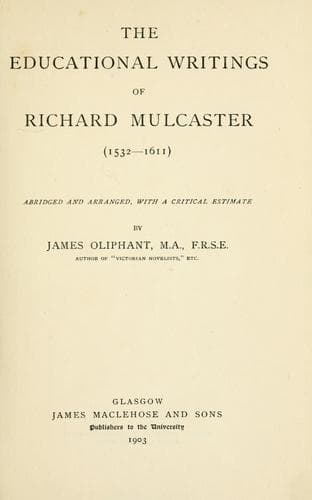
The Educational Writings of Richard MulcasterMulcaster, Richard
History
The Educational Writings of Richard Mulcaster
Mulcaster, Richard
Education -- History
peace, and tends to preserve the State. Our religion does not
condemn any ornament of language which serves the truth and does
not presume overmuch. Nay, may not eloquence be a great blessing
from God, and the trumpet of his honour, as Chrysostom calls that
of St. Paul, if it be religiously bent? Those who have read the
story of the early church find that eloquence in the primitive
Christians overthrew great forces bent against our faith, and
persuaded numbers to embrace the cause, when the power of truth was
joined to force in the word. We should seek eloquence to serve God,
but shun it to serve ourselves, unless we have God’s warrant.
But will you thus break off communication with learned foreigners
by banishing Latin, and putting her learning into your own tongue?
Communication will not cease while people have cause to interchange
dealings, and it may easily be continued without Latin. Already
in some countries, whose languages are akin to the Latin, the
learned class are weaning their tongues and pens from the use of
Latin, both in written discourse and spoken disputation, to their
own natural speech. It is a question not of disgracing Latin, but
of gracing our own language. Why should we honour a stranger more
than our own, if the purpose be served? And although, on account of
the limitations of our language, no foreigner would seek to borrow
from us as we do from other tongues, because we devise nothing new,
though we receive the old, yet we ourselves gain very much in study
by being set from the first in the privy chambers of knowledge,
through the familiarity of our native speech. Justinian the
emperor said to the students of law, when he gave imperial force
to his Institutes, that they were most happy in the advantage of
hearing the Emperor’s voice at first hand, while those of earlier
times were delayed for four whole years. And does not our study
of foreign languages take us fully four years? If this were the
only hindrance indeed, and if we gained otherwise, we could bear
the loss. But it is not only time that is lost in studying foreign
tongues, though we must use them till we learn to do without them.
Who can deny that we understand best in our natural speech, seeing
that all our foreign learning is applied through the medium of our
own language, and learning is of value only in so far as it is
applied to particular uses?
Public-domain text, read in full here on John Shaqi.
Reviews
Reviews
No reviews yet
Be the first to share your thoughts on this work.
Elsewhere in the archive
Join the Discussion
Join the discussion
Sign in to leave a comment or review.
Sign InorCreate an account