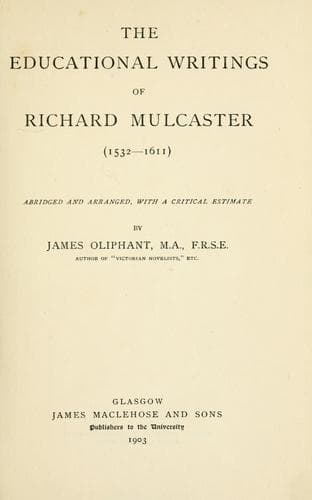
The Educational Writings of Richard MulcasterMulcaster, Richard
History
The Educational Writings of Richard Mulcaster
Mulcaster, Richard
Education -- History
But why not everything in English, a tongue in itself both deep in
meaning and frank in utterance? I do not think that any language
whatsoever is better able to express all subjects with pith and
plainness, if he who uses it is as skilful and well-instructed as
the foreigner. Methinks I myself could prove this in regard to the
most varied subjects, though I am no great scholar, but only an
earnest well-wisher to my own country. And though in dealing with
certain subjects we must use many foreign terms, we are only doing
what is done in the most renowned languages, that boast of their
skill and knowledge. It is a necessity between one country and
another to interchange words to express strange matter, and rules
are appointed for adapting them to the use of the borrowers. It is
an accident which keeps our tongue from natural growth out of its
own resources, and not the real nature of the language, which could
strain with the strongest and stretch to the furthest, either for
the purposes of government, if we were conquerors, or for learning
if we were its treasurers, no whit behind the subtle Greek for
couching close, or the stately Latin for spreading fair. Our tongue
is capable of all, if our people would bestow pains upon it. The
very soil of Greece, it is noted by some, had a refining influence
on Philelphus, who was born in Italy. Italy, says Erasmus, would
have had the same effect on our Sir Thomas More, if he had been
trained there. And cannot labour and practice work as great wonders
in English wits at home as the air can do abroad? Is a change of
soil the best or the only means of furthering growth? Nay, surely
wits are equally sharp everywhere, though where there is less
intercourse and a heavier climate, the labour must be greater to
make up for what is wanting in nature. If such pains be taken we
may boldly arm ourselves with that two-worded and thrice worthy
question--Why not? But grant that it were an heresy, seeing that
we are trained in foreign tongues, even to wish everything to be
in English. Certainly there is no fault in handling in English
what is proper to England, though the same subject well handled in
Latin would be likely to please Latinists. But an English benefit
must not be measured by the pleasure of a Latinist. It is a matter
not for scholars to play with, but for students to practise, where
everyone can judge. Besides, how many shallow things are often
uttered in Latin and other foreign tongues, which under the bare
veil of a strange form seem to be something, but if they were
expressed in English, and the mask pulled off so that everyone
could see them, would make but a sorry show, and soon be disclaimed
even by those who uttered them, with some thought of the old
saying--“Had I known, I would not!” And were it not better to gain
judgment throughout in our own English than either to lose it or
hinder it in Latin or any other foreign tongue? Such considerations
Public-domain text, read in full here on John Shaqi.
Reviews
Reviews
No reviews yet
Be the first to share your thoughts on this work.
Elsewhere in the archive
Join the Discussion
Join the discussion
Sign in to leave a comment or review.
Sign InorCreate an account