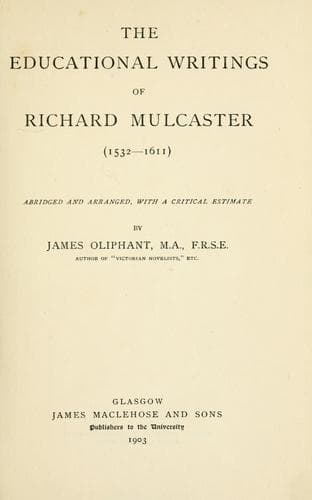
The Educational Writings of Richard MulcasterMulcaster, Richard
History
The Educational Writings of Richard Mulcaster
Mulcaster, Richard
Education -- History
make me thankful for what we have gained from foreign sources, but
at the same time desirous of furthering the interest of my own
natural tongue, and therefore in treating of the first rudiments
of learning I am very well content to make use of English, without
renouncing my right to use Latin or any other learned tongue, when
I come to speak of matters where it may be suitable.
But while my writing in English may seem not amiss for the service
of my country, my manner of writing may offend some in seeming
fastidious and obscure, and I may be brought to task as failing in
what I professed, by dealing with matters too hard for the ignorant
to understand, or using too close a style and too rare terms for
plain folks to follow. All these difficulties are very great foes
to the perception of the ordinary man, who can understand only so
far as he has been trained, and they are no good friends to my
purpose, as I write for the benefit of the many, who are untrained
and unskilful. But although these objections make a very plausible
show, yet I must beg leave to plead my own cause in regard to
matter, style, and the use of terms. Indeed half my answer is
given when I say that I mean well to my country, for in attempting
difficulties one may claim pardon for defects, and what I do is in
the interest of our tongue, which I desire to see enriched in every
way and honoured with every ornament of eloquence, so that it can
vie with any foreign language.
But first to examine the charge of hardness in the subject-matter,
which the reader is said to have difficulty in understanding. In
what, I pray you, consists this hardness that is said to lie in
the matter? Or rather does not all hardness belong to the person,
and not to the thing, in this case as everywhere else? If the
person who undertakes to teach does not know his subject well
enough to make it properly understood, is the thing therefore
hard that is not thoroughly grasped? Or if the learner either
fails to understand owing to deficient knowledge, or will not
make the needful effort owing to some evil disposition, is the
thing therefore hard which is so crossed by personal infirmity?
Surely not. There is no hardness in anything which is expressed
by a learned pen, however far removed from common use, (though to
shield negligence the charge is often made), if the teacher knows
it sufficiently, and the learner be willing and not wayward. For
what are the things which we handle in learning? Are they not of
our own choice? Are they not our own inventions? Are they not
meant to supply our own needs? And was not the first inventor very
well able to open up the thing he invented before he commended it
to others? Or did those who received it do so before they were
instructed as to its use? Or could blunt ignorance have won such
credit in a doubtful case, though professing to bring advantage,
that it was believed before it had persuaded those who had any
Public-domain text, read in full here on John Shaqi.
Reviews
Reviews
No reviews yet
Be the first to share your thoughts on this work.
Elsewhere in the archive
Join the Discussion
Join the discussion
Sign in to leave a comment or review.
Sign InorCreate an account