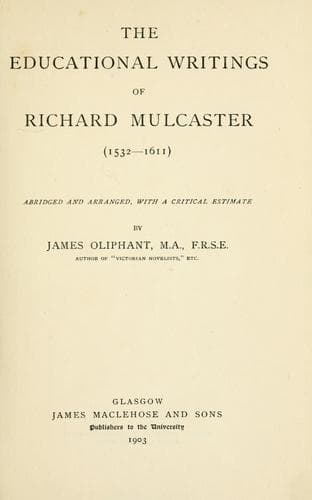
The Educational Writings of Richard MulcasterMulcaster, Richard
History
The Educational Writings of Richard Mulcaster
Mulcaster, Richard
Education -- History
foresight, by plain evidence that the thing was profitable, as well
for the present as for the time to come? If the first inventor
could both find and persuade, his follower must do likewise, or be
at fault himself; he must deliver the matter from the suspicion of
hardness, which arises from his own defect in exposition. If he who
reads fails to grasp the meaning through ignorance, he is to be
pardoned for his infirmity; if having some capacity he fails from
lack of will, he is punished enough by being left in ignorance;
and if while able to follow with the best he keeps with the worst,
blinded understanding is the greatest darkness, and punishes the
evil humour with the depraving of reason. If an expounder, such as
I am now, be himself weak, he is ill-advised if he either writes
before he knows, or does not mend when he has written amiss,
provided he knows where and how. Yet the reader’s courtesy is some
protection against error to him who writes, as the writer’s pardon
is a protection to him who reads, if simple ignorance is the only
fault, without defect in goodwill.
It will be admitted that hardness must arise either from the thing
itself or from the handling. If the thing itself is hard it must
be because it is strange to the reader, because it is outside of
his ordinary interests and occupations, or because he does not
give full study and attention to it. To illustrate the former
difficulty, what affinity is there, in respect of occupation,
between a simple ploughman, a wary merchant, and a subtle lawyer,
or between manual trades and metaphysical discourses, whether in
mathematics, physics, or divinity? Again, even to students who
profess some alliance with what they study, can anything be easy if
they have not laboured sufficiently in it? I need say no more than
this, that where there is no acquaintance in profession there is no
help to understanding, where there is no familiarity there is no
facility, where there is no conference there is no knowledge. If
the man delves the earth, and the matter dwells in heaven, there
is no means of uniting them over so great a distance. But when
the understanding, though in affinity, is clearly insufficient,
there is far more hardness than where there is a difference of
occupation, because a vain conceit brings much more error than
weak knowledge. Some good may come out of an ignorant fellow if
he begin to take hold, but the lukewarm learned mars his way by
prejudiced opinion. But in all this, if there be any difficulty
about the matter, its cause lies in the man, and not in the nature
of the thing. I am quick in teaching, and hard of understanding,
but towards whom and why? Towards him, forsooth, who is not
sufficiently acquainted with the matter in hand. Well, then, if
want of familiarity is the cause of the difficulty, acquaintance
once made and continued will remedy that complaint, if the matter
seem worth the man’s acquaintance in his natural tongue, for that
Public-domain text, read in full here on John Shaqi.
Reviews
Reviews
No reviews yet
Be the first to share your thoughts on this work.
Elsewhere in the archive
Join the Discussion
Join the discussion
Sign in to leave a comment or review.
Sign InorCreate an account