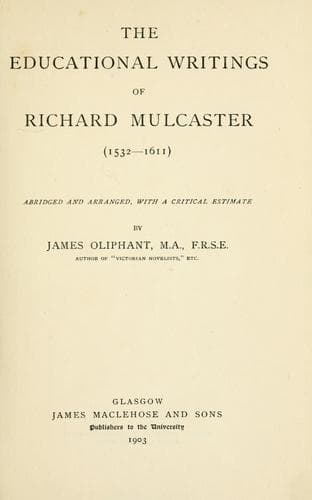
The Educational Writings of Richard MulcasterMulcaster, Richard
History
The Educational Writings of Richard Mulcaster
Mulcaster, Richard
Education -- History
A right estimate of Mulcaster’s temperament, and of his relation
to the surrounding conditions of thought and feeling, is due not
only as a matter of personal justice, but as affording a key to
a proper estimate of his writings. For these have a significance
beyond that of most works of the kind, in forming a somewhat
unique record of historical facts for a bygone period. The attempt
to trace the lines of progress by comparing one phase of culture
with another, has hitherto had imperfect success in the sphere of
education, for, like the arts of music and acting, it works in a
perishable medium, and makes a direct impression only on a single
generation. Even indirect testimony has until recently been almost
entirely wanting. To hardly any writer of earlier times has it
occurred to make any report of the actual conduct of teaching as
it existed around him, for the benefit of future ages. Those who
were interested in the subject have been more concerned to offer
speculative suggestions of reform that have apparently little
organic relation to the conditions of their own community. It is
not so much to the formal treatises of Plato and Aristotle that
we must look for such knowledge as we can obtain of Athenian
education in the fourth century before Christ, as to the incidental
references of writers who had no thought of conveying any definite
or detailed information on the matter. We find the same dearth
of evidence when we try to ascertain the actual working of
educational methods and organisation in the most advanced countries
of Europe during the two or three centuries that succeeded the
Renascence. The contemporary writers on the subject are for
the most part idealists; and while we gladly acknowledge their
services in that capacity, we must regret that to the visionary
outlook of the reformer they did not add the careful observation
of the historian. If Mulcaster is a noteworthy exception to this
rule, it is not because of set purpose he undertook the task of
record and criticism. It was no part of his plan to offer any
narrative or statistical report; indeed he expressly refrains from
commenting on the current practice of teaching, and alludes to
it only incidentally. His intention, as with the great majority
of educational writers, was to suggest improvements, to propose
an ideal; but his responsible position as a headmaster gave him
an ever-present sense of what was practicable, and enabled him
to base his efforts on the firm ground of accomplished fact.
His proposals are so evidently related to the existing state of
affairs that they may almost be taken as affording an historical
record of contemporary practice. The common-sense criticisms of
a shrewd observer like Montaigne, and the dreams of an idealist
such as Rabelais, have their own value; but we shall listen even
more readily to the words of one who speaks out of the fulness of
immediate knowledge, yet with equal power to rouse our aspiration
and energy.
Public-domain text, read in full here on John Shaqi.
Reviews
Reviews
No reviews yet
Be the first to share your thoughts on this work.
Elsewhere in the archive
Join the Discussion
Join the discussion
Sign in to leave a comment or review.
Sign InorCreate an account