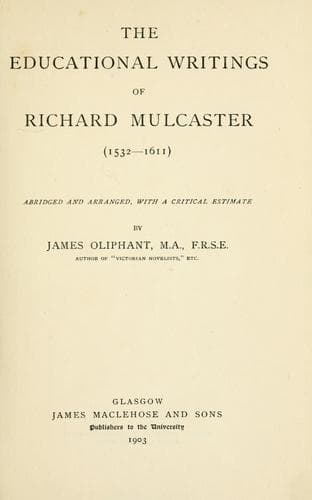
The Educational Writings of Richard MulcasterMulcaster, Richard
History
The Educational Writings of Richard Mulcaster
Mulcaster, Richard
Education -- History
Before considering Mulcaster’s contributions to the theory and art
of education strictly so-called, it will be well to glance at his
influence in the more general aspects of learning and literature.
He must be credited with an important share in the movement towards
the dethronement of Latin in favour of the vernacular tongues, as
the medium of communication in subjects hitherto held to belong
exclusively to the domain of the learned class. The initiative
in this matter goes back, of course, to the time of Dante, but
even with the examples of Italy, France, and Spain to suggest the
change, it was a distinct and difficult task to work it out for
our own language. Mulcaster was not the first Englishman to write
a book in his native tongue which everyone would have expected to
be written in Latin. Sir Thomas More, in some of his historical
and controversial works, Roger Ascham, and a few other writers of
lesser note, had anticipated him in practice, and had been more
successful in attaining a lucid and graceful style, but it may
fairly be claimed that Mulcaster was the first to give a reasoned
justification of the course he followed and recommended, and to
further the end in view by taking definite steps to elaborate the
means. Nor is it only for his service in helping to establish a
canon of literary English, and show the way to others by using it
himself to the best of his ability, that acknowledgment is due. It
was a still more conspicuous merit to see clearly, and to enforce
by these means, the truth that the increase of learning, and the
methods by which it may be furthered, are subjects of interest not
to any limited class alone, but to every member of the community.
There may be comparatively little present value in his judgments
as to the proper content of the English vocabulary, and the forms
of spelling which he thought should be made authoritative, but at
least it is noteworthy that, at a time when linguistic science was
at a rudimentary stage, he had reached a singularly just conception
of the essential nature of a language, and the conditions of its
growth and decay. The interesting allegory where he traces the
process by which speech came to be represented by written symbols,
proves him to have grasped the idea, only in later times fully
understood, that language, as a product of human activity, shares
in all the features characteristic of organic development.
Public-domain text, read in full here on John Shaqi.
Reviews
Reviews
No reviews yet
Be the first to share your thoughts on this work.
Elsewhere in the archive
Join the Discussion
Join the discussion
Sign in to leave a comment or review.
Sign InorCreate an account