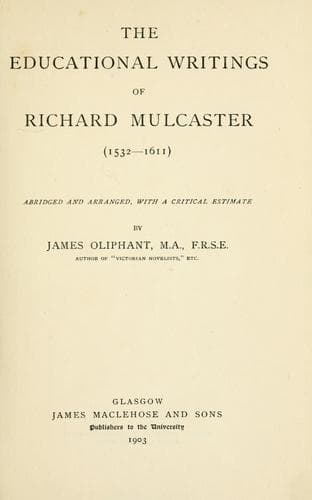
The Educational Writings of Richard MulcasterMulcaster, Richard
History
The Educational Writings of Richard Mulcaster
Mulcaster, Richard
Education -- History
It is not only the more formal aspects of language, moreover, that
he treats with discrimination. On the still subtler question of its
relation to thought and knowledge he speaks with a discernment far
beyond his time. The usurping tyranny of _words_ over the minds
of men, in place of the lawful domination of the realities they
symbolised, had in the movement of the Renascence changed its form
without relaxing its severity. If they were no longer so frequently
used as mere counters in vain disputations, they were yet apt to
be regarded with unreasoning idolatry, as the sacred embodiment of
the thoughts and feelings of settled forms of civilisation in the
past, exempt from any enquiry as to the conceptions they expressed.
Mulcaster does not share this illusion. In his view language is
primarily a means of communication, and though the acquirement of
foreign tongues may be a necessity for the time, yet they “push
us one degree further off from knowledge.” He may not have fully
realised the degree in which language is to be reckoned with as a
form of artistic expression and as an instrument of thought, though
his appreciation of the possibilities of the English tongue shows
that he did not forget these invaluable uses; but in any case he
saw clearly, and he was one of the first to see, that the crying
need of his time was to be set free from the despotism of words,
which made them rather a hindrance than a help to real knowledge.
“We attribute too much to tongues, in paying more heed to them than
we do to matter.” The bearing of this opinion on educational theory
will be considered presently, but it deserves to be noted at the
outset in evidence of the advanced philosophical standpoint of a
writer who belonged to the generation preceding Francis Bacon.
Public-domain text, read in full here on John Shaqi.
Reviews
Reviews
No reviews yet
Be the first to share your thoughts on this work.
Elsewhere in the archive
Join the Discussion
Join the discussion
Sign in to leave a comment or review.
Sign InorCreate an account