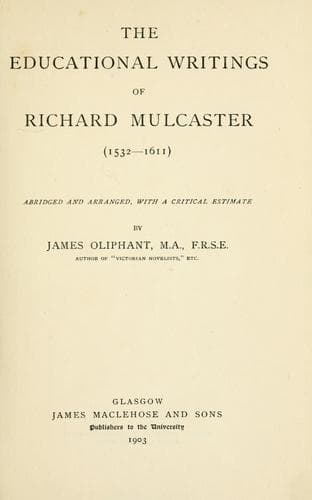
The Educational Writings of Richard MulcasterMulcaster, Richard
History
The Educational Writings of Richard Mulcaster
Mulcaster, Richard
Education -- History
Mulcaster’s independence of conventional practice is further
set beyond doubt by his conception of the place of authority in
argument. Anticipating Locke in deprecating the constant use of
great names in support of a writer’s thesis, he is of course
laying down a principle now so universally accepted that it seems
unnecessary to refer to it, but those who are acquainted with
the Renascence writers of any country know how widely a slavish
regard for the opinions of the classical authors took the place
of a direct appeal to the rational judgment of the reader. It was
no needless service to assign limits to this controversial habit,
to discriminate between superstitious servility and justifiable
deference to previous thinkers, to call for a fearless statement of
the truth as it appeared to each new enquiring spirit, and claim
that it should be tested wholly by its conformity to reason and
nature and experience. Especially valuable for his time was his
insistence on the difference of circumstance between the ancient
and the modern worlds, and between the characters of the various
nations. He may seem to us to carry these distinctions to an
excess when in considering ideal types of human nature he takes
account of the form of government under which each individual has
to live, holding certain qualities appropriate to a monarchy and
others to a republic, but at least he laid a useful emphasis on
the relativity of progress, and on the need for harmony in the
component institutions of a particular form of society.
Public-domain text, read in full here on John Shaqi.
Reviews
Reviews
No reviews yet
Be the first to share your thoughts on this work.
Elsewhere in the archive
Join the Discussion
Join the discussion
Sign in to leave a comment or review.
Sign InorCreate an account