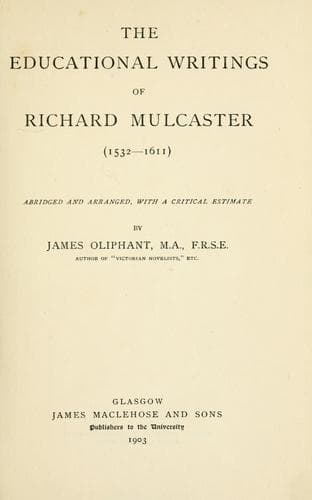
The Educational Writings of Richard MulcasterMulcaster, Richard
History
The Educational Writings of Richard Mulcaster
Mulcaster, Richard
Education -- History
Another proof of Mulcaster’s general enlightenment may be found
in the fact that he was the first of his countrymen to affirm
seriously that education was the birthright of every child born
into the community. It is not intended to suggest by this that
he anticipated the full assumption by the State of the duty of
providing and enforcing universal education, but rather that he
desired to foster a public sentiment and social conditions which
would be favourable to the idea that the rudiments of learning
should by one means or another be distributed throughout the whole
body of the nation. Efforts in this direction had been made in
other countries under the levelling influence of the reforming
spirit in religion, but in England, where the change of faith
had been less associated with a democratic impulse, nothing had
as yet been done to popularise education in the proper sense
of the term, and public opinion had still to be prepared for
the movement. It is true that the sharp distinctions of rank
which the sixteenth century inherited from the Middle Ages were
never so absolutely marked in the sphere of learning as in other
departments of life. Though the child of lowly birth could never
become a gentleman, he could become a scholar. The helping hand
extended by the Church to the promising boy of low degree did
not, however, imply any relaxation of caste feeling so far as the
general supply of educational facilities was concerned. The humble
scholar was raised out of his own class, and was always regarded
as an exception. Taken in the mass, the gentry and the commonalty
were clearly separated, and no kind of training was thought in
any way due to the latter except such as might make them directly
serviceable to their betters. For the first notable attack on this
fundamental article of medieval faith, apart from the indirect
and interested claims of the Reformation leaders to the means of
influencing the young, credit is generally given to Comenius. But
it must be remembered that half a century before his time, and in
a country where the _régime_ of social status has always held a
firm position, a strong protest against educational exclusiveness
was raised by Richard Mulcaster, who maintained that the elements
of knowledge and training should be recognised as the privilege
of all, irrespective of rank or sex, and without regard to their
future economic functions. “As for the education of gentlemen,”
he writes, “at what age shall I suggest that they should begin to
learn? Their minds are the same as those of the common people, and
their bodies are often worse. The same considerations in regard to
time must apply to all ranks. What should they learn? I know of
nothing else, nor can I suggest anything better, than what I have
already suggested for all.” And his unwillingness to recognise any
kind of disability in matters of education, except what was proved
by the test of experience to be natural, is further shown in his
Public-domain text, read in full here on John Shaqi.
Reviews
Reviews
No reviews yet
Be the first to share your thoughts on this work.
Elsewhere in the archive
Join the Discussion
Join the discussion
Sign in to leave a comment or review.
Sign InorCreate an account