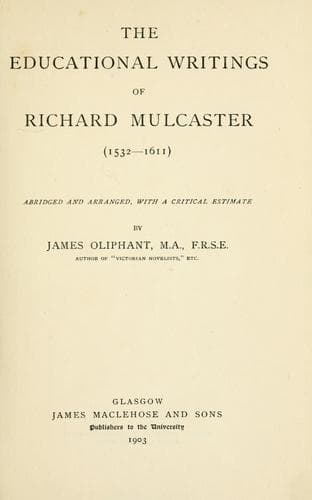
The Educational Writings of Richard MulcasterMulcaster, Richard
History
The Educational Writings of Richard Mulcaster
Mulcaster, Richard
Education -- History
insistence that, as far as may be possible, girls should have the
same advantages as boys. Though, as he says, in deference to the
general feeling of his time and country he will not go so far as
to propose that girls should be admitted to the grammar schools
and universities, he not only wishes them to share in all the
opportunities of elementary education, but he wholly approves of
the ideal of higher culture for women, which was represented in the
attainments of Queen Elizabeth herself.
We may now turn to matters that are less the concern of the
philosophic thinker and social observer than of the expert in
educational practice. Let us first examine Mulcaster’s conception
of the content of a liberal education, from the two points of view,
as to how far it should embrace a culture of the whole nature,
and as to the proper range of distinctively mental studies. It is
a matter of history that in both these respects the Renascence
ideal had fallen away from the example of the Greeks. Intellectual
culture had to a large extent been dissociated from physical and
moral training. The life of the scholar was a thing apart from the
conception of chivalry, which encouraged the physical prowess and
regard to a code of honour that were developed by the military
class. The formal profession of a religious end in learning took
the place of a genuine cultivation of character, and while this
restricted path was open to the more gifted of the poorer classes,
the alternative ideal was reserved for the upper social ranks.
It is true that in our own country in the Elizabethan era there
was some reconciliation of these diverse aims in the persons of
such men as Walter Raleigh and Philip Sidney, but the type they
represented was quite exceptional, and had no apparent influence on
general educational methods. There was great need for Mulcaster’s
plea that in the upbringing of children we should return to the
ideal expressed in Juvenal’s familiar phrase, “mens sana in
corpore sano.” No stress need be laid on the particular forms of
physical exercise which he recommended. His suggestions here were
not original, and the present time has little to learn from the
physiological conceptions of the sixteenth century. But what was
really instructive in his own day, and is scarcely less so in
ours, is the intimate relation he conceived to exist between the
body and the mind--a relation that demanded a harmonious training
of the whole nature. “The soul and the body being co-partners in
good will, in sweet and sour, in mirth and mourning, and having
generally a common sympathy and mutual feeling, how can they be,
or rather why should they be, severed in education?... As the
disposition of the soul will resemble that of the body, if the
soul be influenced for good, it will affect the body also.” His
use of the term _soul_, moreover, is significant of the conviction
which underlies all his writing, that the end of all physical
Public-domain text, read in full here on John Shaqi.
Reviews
Reviews
No reviews yet
Be the first to share your thoughts on this work.
Elsewhere in the archive
Join the Discussion
Join the discussion
Sign in to leave a comment or review.
Sign InorCreate an account