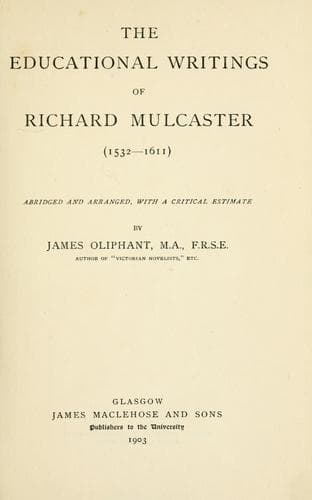
The Educational Writings of Richard MulcasterMulcaster, Richard
History
The Educational Writings of Richard Mulcaster
Mulcaster, Richard
Education -- History
intellectual training is the development of the feelings that
prompt to right conduct. He was not carried away by the current
craze for book-learning into accepting as a legitimate end of
education the pursuit of knowledge for its own sake; in his view
the teacher must always have regard to the unfolding of the whole
character that would bear fruit in the discharge of the duties of
citizenship and other activities of a complete life. Not that he
wished the school to assume any preponderating control over the
child, either in the direction of opinion or in moral ascendency.
He had too clear an insight into the springs of conduct to ignore
the potency of the earliest influences of the home, and so far
from seeking to usurp the authority of parents in determining
their children’s lives, he urges the closest co-operation and
good feeling among all who have the pupil’s welfare at heart.
Some further insight will be gained into his comprehensive ideal
of upbringing when we come to consider his appreciation of home
influence more closely, but it may first be asked what his
conception was of the mental cultivation that should be aimed at in
a liberal curriculum. In regard to the secondary or grammar school
period of education, with which he was most intimately acquainted,
though he has many acute criticisms and luminous suggestions to
offer, his expressed intention of supplying a systematic treatment
was unfortunately left unfulfilled; and of his ideas as to
university teaching we have little more than a sketch of proposed
reforms. On these points something may presently be said, but we
may turn first to his contributions towards the establishment of
a sound elementary system, which he held to be the most important
stage of all, because it was the only form of education that could
be brought within the reach of every child, and was the foundation
of all further progress in learning. Even this part of the task
that he imposed on himself remains incomplete, but there is
material enough for a judgment of his point of view. It would seem
that in England, up to the Elizabethan era at least, no provision
had ever been made for rudimentary instruction for any except those
who were destined to proceed to the higher stages of learning,
and that the elementary training given to these select few was
limited to the barest preparation for the traditional study of the
classics. The reading and writing of the vernacular must have been
acquired up to a certain point before the Latin grammar could be
attacked, but it is clear that no adequate justice was done even to
these preliminary subjects, and that no attempt was made to include
a deliberate training of the senses and activities of the child.
Mulcaster’s proposals as to an elementary course certainly do not
sound revolutionary. His subjects coincide pretty nearly with our
familiar “three R’s,” and he is himself careful to show that he is
merely “reviving” what is commended by the precepts of the wise
Public-domain text, read in full here on John Shaqi.
Reviews
Reviews
No reviews yet
Be the first to share your thoughts on this work.
Elsewhere in the archive
Join the Discussion
Join the discussion
Sign in to leave a comment or review.
Sign InorCreate an account