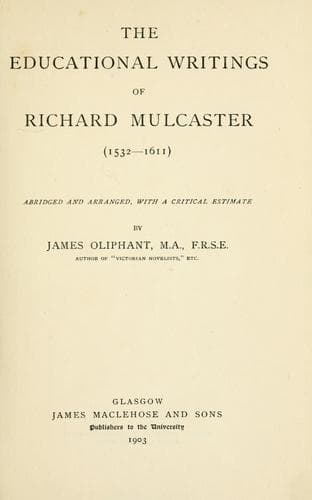
The Educational Writings of Richard MulcasterMulcaster, Richard
History
The Educational Writings of Richard Mulcaster
Mulcaster, Richard
Education -- History
men of old, and by the practice of the greatest States. But it was
no small merit to be the first to perceive that such a revival was
possible and desirable in his own time and country, and when his
proposals are examined it will be found that in the spirit in which
he conceived them they were far in advance alike of contemporary,
and of much later, thought and practice. It is a well-known
criticism of his contemporary, Montaigne, that teachers were apt to
think too much of the matter that was to be taught, and too little
of the nature of the learner. That this remark was just in relation
to these times we can well believe when we consider how recently
the traditional bearing of the schoolmaster has been associated
rather with the harsh enforcement of uncongenial tasks under the
threat of penalties than with the sympathetic encouragement of
willing and interested labours. Ascham had protested against the
short-sighted severity of teachers, but failed to see that its
root lay in the fact that the studies presented were generally
ill-adapted to the capacities and inclinations of the scholars.
Mulcaster, on the other hand, recognised that the remedy must be
sought in the discovery of a more reasonable method, towards which
he had definite constructive proposals to offer. He may even be
said to have anticipated by a couple of centuries the doctrine
of Rousseau, afterwards utilised by Pestalozzi and Froebel, that
the paramount aim of the teacher is not to communicate knowledge,
but to stimulate and guide the natural activity of the child. It
is to be noted that every one of the five subjects he proposed to
teach in the elementary school is of the nature of an art, calling
for independent action on the part of the learner, and giving
pleasurable exercise to the senses and bodily organs as well as
to the intelligence. It was more than a happy intuition that led
him to give so honourable a place to drawing and music; it was a
consistent application of his doctrine that the minds of young
children must be fed through the channels of sense perception, and
that faculty is to be developed by placing the outlets of energy
in immediate contact with the powers of acquisition. Drawing
was intended to give a direct and practical knowledge of space
relations and of the forms of natural objects, by combining the
activities of eye and hand, while at the same time it favoured
the cultivation of artistic expression. Music, being based on
varied arrangements of number in pitch and time, was counted on
to supply the ground-work of arithmetic, while in accordance with
the persuasion of the Greeks it was held to exercise a definite
æsthetic and moral influence on character. That Mulcaster had not
only thought out his theories on the matter, but had verified
them by individual child-study, is clear from the terms of his
recommendations. “We must seek for natural inclinations in the
soul, which seem to crave the help of education and nurture, and
Public-domain text, read in full here on John Shaqi.
Reviews
Reviews
No reviews yet
Be the first to share your thoughts on this work.
Elsewhere in the archive
Join the Discussion
Join the discussion
Sign in to leave a comment or review.
Sign InorCreate an account