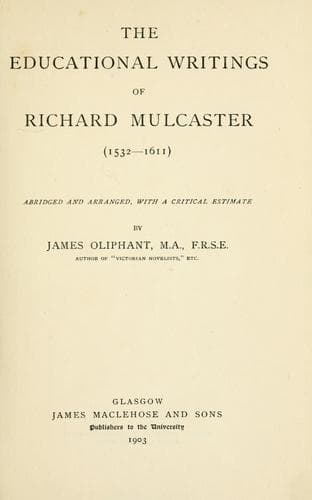
The Educational Writings of Richard MulcasterMulcaster, Richard
History
The Educational Writings of Richard Mulcaster
Mulcaster, Richard
Education -- History
by means of these may be cultivated to advantage.... The best way
to secure good progress, so that the intelligence may conceive
clearly, memory may hold fast, and judgment may choose and discern
the best, is so to ply them all that they may proceed voluntarily
and not with violence.”
The same insight into the heart of the educational process appears
in his treatment of the grammar-school curriculum. When we remember
the absorbing pre-occupation with classical learning that was the
distinctive mark of the Renascence scholars, and the prominence
given in consequence to linguistic study in education, we should
not wonder if Mulcaster were found acquiescing in some degree in
the narrow ideal that exalted knowledge at the expense of faculty,
and laid more stress on the interpretation of words than of things.
What will rather excite our surprise and admiration is the extent
to which he was able to rise above the contemporary estimate of the
value of Latin and Greek as instruments of culture. It is from the
pen of one whose reputation in his own day was based on his mastery
of ancient languages and his success as a teacher of the classics,
that we have the clearest statement of the contrast between the
indirect, incidental value of linguistic training, and the direct,
formative influences of scientific study. “In time all learning may
be brought into one tongue, and that naturally understood by all,
so that schooling for tongues may prove needless, just as once they
were not needed; but it can never fall out that arts and sciences
in their essential nature shall be anything but most necessary for
every commonwealth that is not utterly barbarous.... The sciences
that we term ‘mathematical’ from their very nature always achieve
something good, intelligible even to the unlearned, by number,
figure, sound, or motion. In the manner of their teaching also
they plant in the mind of the learners a habit of resisting the
influence of bare probabilities, of refusing to believe in light
conjectures, of being moved only by infallible demonstrations.”
Public-domain text, read in full here on John Shaqi.
Reviews
Reviews
No reviews yet
Be the first to share your thoughts on this work.
Elsewhere in the archive
Join the Discussion
Join the discussion
Sign in to leave a comment or review.
Sign InorCreate an account