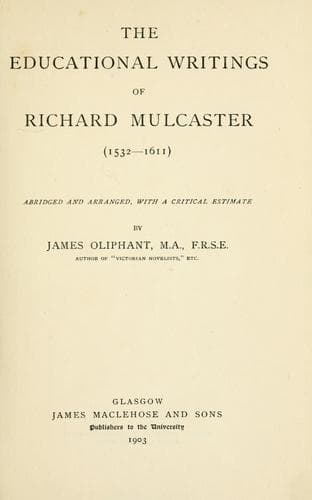
The Educational Writings of Richard MulcasterMulcaster, Richard
History
The Educational Writings of Richard Mulcaster
Mulcaster, Richard
Education -- History
It has been stated above that Mulcaster had reached a conception
distinctly in advance of his time in regard to the true
significance of words, as the signs of realities in the outer
world and of the impressions these realities make upon the mind.
We may here notice the influence of this conception on his
treatment of linguistic study as a means of education. While fully
admitting the necessity for acquiring the classical languages
as long as these continued to be the only vehicles of learning,
he never fails to regret the loss of time absorbed in studying
them, and he anticipates with satisfaction the time when modern
tongues, and especially his own, will be sufficiently developed
and refined to replace Latin and Greek, believing as he does that
“all that bravery may be had at home that makes us gaze so much
at the fine stranger.” Not that he ever forgets that words are
something more than mere symbols, that indeed they come to have a
certain objective reality of their own, which must be apprehended
as directly as that of any other natural phenomenon. “Do we not
learn from words?” he asks. “No marvel if it is so, for a word is
a metaphor, a learned translation, something carried over from
its original sense to serve in some place where it is even more
properly used, and where it may be most significant, if it is
properly understood. Take pains to learn from it; you have there
a means of gaining knowledge.” But this appreciation of the inner
significance of language does not blind him to the fact, apparently
unperceived by all his contemporaries, that the unfortunate need
for devoting so much time and energy to linguistic study was a very
serious hindrance to the natural unfolding of the mental faculties
through a reasonable education. In his own words, “we were forced
... to deal with the tongues, ere we pass to the substance of
learning; and this help from the tongues, though it is most
necessary, as our study is now arranged, yet hinders us in time,
which is a thing of great price--nay, it hinders us in knowledge,
a thing of greater price. For in lingering over language, we are
removed and kept back one degree further from sound knowledge, and
this hindrance comes in our best learning time.” And in another
passage he bewails the “loss of time over tongues, while you are
pilgrims to learning,” and the “lack of sound skill, while language
distracts the mind from the sense.” Where could we find a stronger
indictment of the Public School tradition that banishes every form
of nature study during the “best learning time,” the years when the
powers of observation are in their first freshness, for the sake of
a premature initiation into the subtleties of Latin Grammar?
Public-domain text, read in full here on John Shaqi.
Reviews
Reviews
No reviews yet
Be the first to share your thoughts on this work.
Elsewhere in the archive
Join the Discussion
Join the discussion
Sign in to leave a comment or review.
Sign InorCreate an account