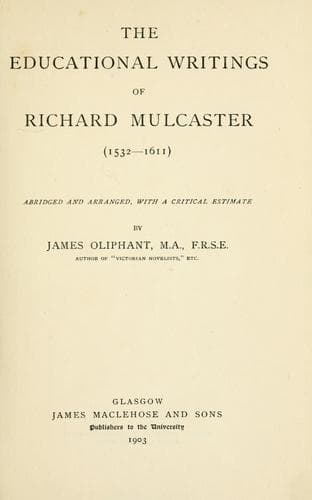
The Educational Writings of Richard MulcasterMulcaster, Richard
History
The Educational Writings of Richard Mulcaster
Mulcaster, Richard
Education -- History
We may pass to another important question with which Mulcaster
deals in a spirit in harmony with his enlightened conception of
general instruction. His assumption that the day-school is the
normal arrangement, and that either an entirely private or a
boarding-school education requires to be justified by special
circumstances, gives him a far wider outlook and a safer standpoint
than can be claimed for theorists, whose ideal, like that of Locke,
regards only the upbringing of a gentleman’s son at home under a
tutor, or, like that of Milton, involves the collection of large
numbers in boarding establishments of a conventual nature. This is
a matter that is naturally related to the extension of educational
opportunities throughout all classes of the community. As long
as only a select few were thought fit for learning, residence
in the monastery was almost an affair of necessary convenience,
but when teaching came to be more widely offered, the day-school
became a recognised institution, and such other arrangements as
implied greater expenditure were retained only by the rich, as
instruments of social exclusiveness. It is in countries where
distinctions of rank are comparatively little marked that the
day-school system has flourished most, and the partiality shown
in Mulcaster’s day for the services of a private tutor, and in
subsequent times for the boarding-school, is certainly to be taken
in great measure as an assertion of class superiority. Mulcaster
was no democrat, but he saw that the rich had more to lose than
to gain by arrangements that unduly restricted their experience.
Moreover he clearly discerned the importance of the family as
the true social unit, the nursery of the virtues that should be
developed in the school, and find exercise in the public, as well
as the private, conduct of life. It is not his fault that his
countrymen have become bound hand and foot to a system under which
the vast majority of well-to-do parents hand over their children,
body and soul, from the tenderest years to the care of professional
upbringers, divesting themselves with a light heart of the most
precious responsibilities that nature has conferred on them. “How
can education be private?” he asks, “It is an abuse of the name as
well as of the thing.” But on the other hand he urges--“All the
considerations which persuade people rather to have their children
taught at home than along with others outside, especially with
regard to their manners and behaviour, form arguments for their
boarding at least at home, if the parents will take their position
seriously.... They are distinct offices, to be a parent, and a
teacher, and the difficulties of upbringing are too serious for all
the responsibilities to be thrown into the hands of one alone.”
Public-domain text, read in full here on John Shaqi.
Reviews
Reviews
No reviews yet
Be the first to share your thoughts on this work.
Elsewhere in the archive
Join the Discussion
Join the discussion
Sign in to leave a comment or review.
Sign InorCreate an account