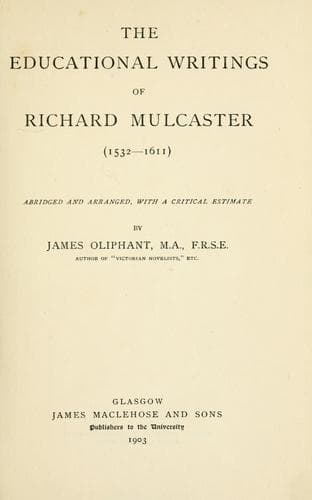
The Educational Writings of Richard MulcasterMulcaster, Richard
History
The Educational Writings of Richard Mulcaster
Mulcaster, Richard
Education -- History
On the question of the position and standing of the teacher
Mulcaster’s contentions were scarcely more timely and just for his
own generation than they are for the present time. Though certain
ranks of the teaching profession have never been without social
consideration, it remains true that teachers as a whole were long
regarded as an inferior order of the clergy, who did not reach the
goal of their ambition until they had succeeded in leaving their
first calling, to take the more tranquil and dignified position
of a cure of souls. As he puts it--“The school being used but
for a shift, from which they will afterwards pass to some other
profession, though it may send out competent men to other careers,
remains itself far too bare of talent, considering the importance
of the work.” It was only natural that the profession should
suffer from this want of independence, in the general esteem, and
therefore in its substantial rewards, but the claim which our
author puts forward for greater public consideration, is obviously
based, not on any petty resentment on behalf of himself or his
fellows, but on broad general grounds of social advantage. He
had a high sense of the importance of the teacher’s task for the
national welfare, and he was anxious on all grounds that those
most fitted to fulfil it with success, should in the first place
be induced to enter the profession by the prospect of adequate
recognition, and in the second place have sufficient opportunity
of training to enable them to do justice to it. “I consider that
in our universities there should be a special college for the
training of teachers, inasmuch as they are the instruments to make
or mar the growing generation of the country ... and because the
material of their studies is comparable to that of the greatest
profession, in respect of language, judgment, skill in teaching,
variety in learning, wherein the forming of the mind and exercising
of the body require the most careful consideration, to say nothing
of the dignity of character which should be expected from them.”
Mulcaster, it will here be seen, has good grounds to offer for
magnifying his office, and striving to win a place of honour for
it in the social economy. Subsequent experience has tended to
suggest that his effort to gain greater consideration for his
profession was more utopian than could perhaps have appeared to
his contemporaries. There are certain general reasons why in a
country like ours the teaching profession cannot be expected to
reach the solidarity that belongs, for example, to the profession
of medicine or of law. The wide economic differences in our
civilisation inevitably perpetuate distinctions of rank, which are
nowhere more clearly shown than in the choice of schools. It is
natural and right that parents should be no less concerned about
the companionship they provide for their children than about the
quality of the teaching, and since a free and compulsory education
Public-domain text, read in full here on John Shaqi.
Reviews
Reviews
No reviews yet
Be the first to share your thoughts on this work.
Elsewhere in the archive
Join the Discussion
Join the discussion
Sign in to leave a comment or review.
Sign InorCreate an account