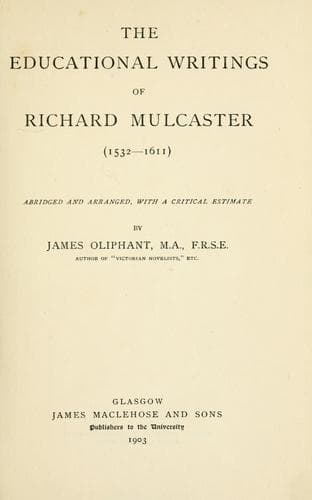
The Educational Writings of Richard MulcasterMulcaster, Richard
History
The Educational Writings of Richard Mulcaster
Mulcaster, Richard
Education -- History
has brought into the national schools not only the poorest but the
lowest class, those who can afford it must be excused, and even
commended, if they take advantage of other opportunities, where
some principle of selection is applied. And as there are different
classes of children, representing on the whole different kinds of
home-upbringing, so there will be different ranks of teachers,
varying widely in their status and emoluments. The question of
numbers will always among day-schools give the town teacher an
advantage over his country brother; the question of fees, in so far
as these are not counter-balanced by endowments or State support,
will draw the most highly-qualified teachers to the schools that
serve the rich; and the secondary teacher will, on the whole, rank
above the elementary teacher, partly because greater attainments
are required from him, and partly because the higher teaching,
requiring a prolonged school course, is demanded chiefly by the
well-to-do classes. That this economic differentiation would
become so marked could scarcely have been foreseen three centuries
ago, and even though it already existed, Mulcaster was doing good
service in protesting against its extremer forms. His claim that
the elementary teacher is the most important of all, that he
should have the smallest classes to deal with, and that he should
be the most highly paid, must of course be taken as a counsel of
perfection, but if there is no present prospect of its being fully
admitted in practice, there is certainly a growing acceptance of
the principle underlying it, that the most critical period of
education is in the early years, when the first impressions are
being received, and that no influence deserves to be so well
considered as that which is to call forth an individual response
from the awakening intelligence.
Difficult as the attainment of Mulcaster’s ideal of the position
of teachers may have been, he was undoubtedly on the right path to
seek it, when he advocated that their training should be entrusted
to the universities. The demand for adequate preparation is the
only reasonable means of securing at once a fitting status, and a
reward sufficient to attract the best talent, and the recognition
of the work of education as deserving to rank with the other
learned professions for which a special academic training is
required, is the natural expression of a healthy public sentiment
on the matter. The higher the requirements are pitched, the safer
will be the guarantee that aspirants will be drawn to the work by
a genuine belief in it as their true vocation, for the sake of
which it is worth while to make some sacrifice. The atmosphere of a
university, moreover, offers the fullest opportunity to the teacher
of acquiring the breadth of general culture, and the _savoir
vivre_, in which he is so apt to be deficient.
Public-domain text, read in full here on John Shaqi.
Reviews
Reviews
No reviews yet
Be the first to share your thoughts on this work.
Elsewhere in the archive
Join the Discussion
Join the discussion
Sign in to leave a comment or review.
Sign InorCreate an account