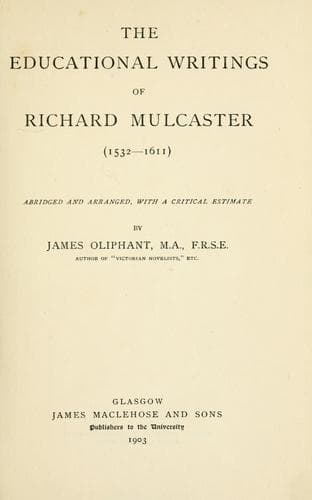
The Educational Writings of Richard MulcasterMulcaster, Richard
History
The Educational Writings of Richard Mulcaster
Mulcaster, Richard
Education -- History
Mulcaster’s proposals for university reform in general will be
found in several important respects to have anticipated the course
of subsequent legislation. He wished the State to have a free
hand in controlling the uses of private endowments according to
the special needs of each generation, as long as the confidence
of the original founders was not betrayed, and he was not slow
to point out directions where he considered that changes were
urgently needed. We know that in his time the condition of the
Universities of Oxford and Cambridge was far from satisfactory,
partly because definite abuses had crept in, and partly because
their constitution naturally offered a passive resistance to
regulative organisation. Mulcaster’s suggestions all tend to
greater concentration of aim and facility of classification. He may
have carried his desire for uniformity too far when he advocated
the specialisation of every college to a particular study, and
even to a particular stage in that study. So far as residence
is concerned there is surely no need to forgo the benefits of a
varied social intercourse among students of different standing
and pursuits, but it cannot be doubted that every effort should
be made to counteract the loss this may entail by providing full
opportunities throughout the whole university for the emulation of
those who are in the same academic position. In Elizabethan days
there was not the same freedom of interchange in lectures among the
various colleges that now obtains, and Mulcaster was doing good
service in deprecating the isolation and dispersion of interest
that interfered with progress. We must also commend the discernment
he showed in presenting the claims of a definite and comprehensive
curriculum in general learning to the attention of those who wished
to engage in professional studies, as well as his zeal for the more
careful selection of candidates for scholarships, fellowships, and
degrees. Nor is it to be forgotten that he was probably the first
to suggest the appointment of “readers” in the universities,--an
arrangement that was not adopted till almost our own time.
Public-domain text, read in full here on John Shaqi.
Reviews
Reviews
No reviews yet
Be the first to share your thoughts on this work.
Elsewhere in the archive
Join the Discussion
Join the discussion
Sign in to leave a comment or review.
Sign InorCreate an account