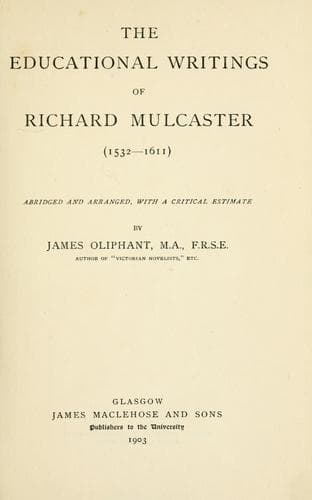
The Educational Writings of Richard MulcasterMulcaster, Richard
History
The Educational Writings of Richard Mulcaster
Mulcaster, Richard
Education -- History
The significance of Mulcaster’s theories may best be appreciated
by comparing them with those of the great educational reformer who
came next in order of time. The services rendered to the world by
Comenius are too well accredited, and too widely acknowledged, to
suffer any serious loss of prestige by such a comparison. It has
been already urged that true originality in social affairs means an
enlightened judgment as to what is possible and desirable for one’s
own time and country, and the reform of education had to be worked
out and proclaimed for continental Europe on independent lines. It
is not likely that Mulcaster’s writings had any direct influence on
Comenius, though they could hardly fail to make some contribution
to the general stock of ideas that is successively inherited by
each generation, and spreads almost imperceptibly over an ever
widening area. Even apart from any claim to priority in doctrine,
the forcible personality of the Moravian writer, expressing
itself in a singularly exhaustive treatment of educational
problems and their practical application, will always assure to
him an unquestioned authority, while his assertion of the weighty
principle that words and things must be taught together, spoken
and written signs being constantly associated with the objects,
qualities, or actions they represent, is in itself enough to secure
him a lasting reputation. But from the national point of view,
which in tracing such historical successions it is not unreasonable
to assume, we may justly note that there are a considerable
number of educational doctrines, now generally accepted among us
in theory if not in practice, the earliest formulation of which,
though generally ascribed to Comenius, is really to be found in the
writings of Richard Mulcaster. More than this, it may be maintained
that on several important points a more penetrating insight was
shown by our own countryman, in spite of his disadvantage in time.
In regard both to the end and the scope of education, for example,
a more humanistic conception seems to have been held by Mulcaster.
Unlike Comenius, who lays chief stress on the preparation for
eternity, he sets forth as the main purpose of youthful training
the more proximate aims of self-realisation and useful service to
one’s fellowmen. “The end of education and training is to help
nature to her perfection in the complete development of all the
various powers ... whereby each shall be best able to perform all
those functions in life which his position shall require, whether
public or private, in the interest of his country in which he was
born, and to which he owes his whole service.” And while both
writers insist that the rudiments of learning should be taught to
children of every social class and of both sexes, the Englishman
alone expresses sympathy with the ideal of a higher education for
girls where circumstances permit. It would seem also that Mulcaster
Public-domain text, read in full here on John Shaqi.
Reviews
Reviews
No reviews yet
Be the first to share your thoughts on this work.
Elsewhere in the archive
Join the Discussion
Join the discussion
Sign in to leave a comment or review.
Sign InorCreate an account