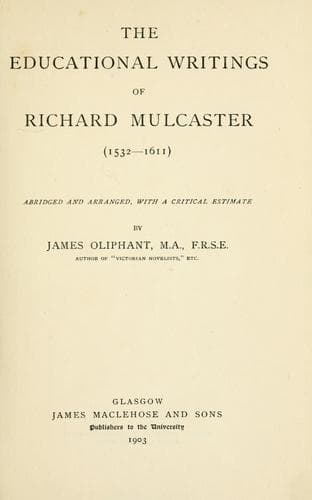
The Educational Writings of Richard MulcasterMulcaster, Richard
History
The Educational Writings of Richard Mulcaster
Mulcaster, Richard
Education -- History
took the more reasonable view of the relation of a teacher to his
class, for his claim that the elementary master should have the
smallest number to deal with, at least shows a fuller sense of the
importance of individual treatment than is conveyed in the later
writer’s dictum that it does not matter how large a class is if the
teacher has monitors to help him.
Among the doctrines of Comenius to which his expositors have
attached special importance may be numbered the following: that
the earliest teaching should be given in the vernacular; that the
first subjects taught should be such as give scope to the child’s
activity; that knowledge should be communicated through the
senses and put to immediate use; that examples should be taught
before rules; that the arts should be taught practically; that
in language-study grammar should accompany reading and speaking;
that learning should be spontaneous and pleasant without undue
pressure; that children should not be beaten for failure in
study, but only for moral offences; and that education should
follow in general the guidance of nature. These principles now
rank among the commonplaces of educational method, and in so far
as their acceptance has been furthered by the persuasive advocacy
of Comenius the gratitude of the world is due to him; but why
should Englishmen forget that they had all been proclaimed with
unmistakable clearness in this country half a century earlier?
Readers of the foregoing pages must be already convinced that
the doctrines in question form an essential part of Mulcaster’s
theory of education; but it may be worth while to recall in a
connected form a few of the more striking passages in which they
are expressed. On the use of the vernacular in the early years:
“As for the question whether English or Latin should be first
learned, hitherto there may seem to have been some reasonable
doubt, although the nature of the two tongues ought to decide the
matter clearly enough, ... but now ... we can follow the direction
of reason and nature in learning to read first that which we
speak first, to take most care over that which we use most, and
in beginning our studies where we have the best chance of good
progress, owing to our natural familiarity with our ordinary
language, as spoken by those around us in the affairs of everyday
life.” No particular quotation is needed to illustrate Mulcaster’s
dependence for his elementary training on studies that called
forth individual effort from the child, for the course he planned
includes no other kind of occupation, but the following sentences
may stand for a proof that he recognised the natural channels
through which knowledge is acquired and utilised in the guidance of
action: “Nature has ... given us for self-preservation the power
of perceiving all sensible things by means of feeling, hearing,
seeing, smelling, and tasting. These qualities of the outward
world, being apprehended by the understanding and examined by the
Public-domain text, read in full here on John Shaqi.
Reviews
Reviews
No reviews yet
Be the first to share your thoughts on this work.
Elsewhere in the archive
Join the Discussion
Join the discussion
Sign in to leave a comment or review.
Sign InorCreate an account