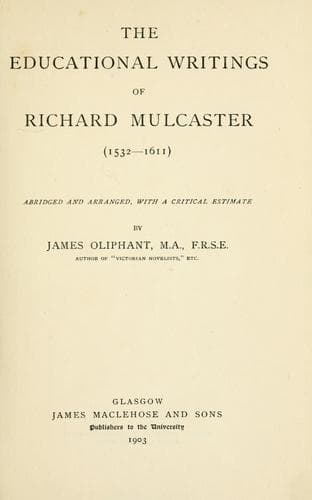
The Educational Writings of Richard MulcasterMulcaster, Richard
History
The Educational Writings of Richard Mulcaster
Mulcaster, Richard
Education -- History
judgment, are handed over to the memory, and afterwards prove our
chief--nay, our only--means of obtaining further knowledge....
To serve the end both of sense-perception and of motion, nature
has planted in the body a brain, the prince of all our organs,
which by spreading its channels through every part of our frame,
produces all the effects through which sense passes into motion.”
On the point of subordinating rules to the imitation of examples,
and learning the arts by practically engaging in them, Mulcaster
writes: “Children know not what they do, much less why they do
it, till reason grow into some ripeness in them, and therefore
in their training they profit more by practice than by knowing
why, till they feel the use of reason, which teaches them to
consider causes.... When the end of any art is wholly in doing, the
initiation should be short, so as not to hinder that end by keeping
the learners too long musing upon rules.... We must keep carefully
that rule of Aristotle which teaches that the best way to learn
anything well which has to be done after it is learned, is always
to be a-doing while we are a-learning.” To the question of the
best method in linguistic study, Mulcaster was ready to apply this
principle of learning directly through practice, and his sense of
the proper place of grammatical knowledge is shown in the following
passage: “Grammar in itself is but the bare rule, and a very naked
thing.... In grammar, which is the introduction to speech, there
should be no such length as is customary, because its end is to
write and to speak, and in doing this as much as possible we learn
our grammar best, when it is applied to matter and not clogged with
rules. As for understanding writers, that comes with years and
ripeness of intelligence, not by means of the rules of grammar.” It
has already been seen that Mulcaster shared fully in the humaner
views upon the treatment of children that were beginning to assert
themselves in his day; but it is interesting to notice that he
based his conviction not only on the general claims of sympathy,
but also on grounds of purely educational expediency. “These three
things--perception, memory, and judgment--ye will find peering
out of the little young souls. Now these natural capacities being
once discovered must as they arise be followed with diligence,
increased by good method and encouraged by sympathy, till they come
to their fruition. The best way to secure good progress, so that
the intelligence may conceive clearly, memory may hold fast, and
judgment may choose and discern the best, is so to ply them that
all may proceed voluntarily, and not with violence, so that the
will may be ready to do well and loth to do ill, and all fear of
correction may be entirely absent. Surely to beat for not learning
a child that is willing enough to learn, but whose intelligence
is defective, is worse than madness.... Beating must only be for
Public-domain text, read in full here on John Shaqi.
Reviews
Reviews
No reviews yet
Be the first to share your thoughts on this work.
Elsewhere in the archive
Join the Discussion
Join the discussion
Sign in to leave a comment or review.
Sign InorCreate an account