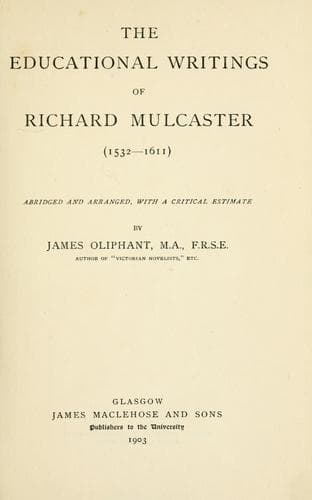
The Educational Writings of Richard MulcasterMulcaster, Richard
History
The Educational Writings of Richard Mulcaster
Mulcaster, Richard
Education -- History
ill-behaviour, not for failure in learning.” Finally we must admit
that the principle urged by Comenius, and afterwards pushed to
an extreme by Rousseau and Froebel, of following the guidance of
nature in planning the procedure of instruction was explicitly
stated by Mulcaster. “The third proof of a good elementary course
was that it should follow nature in the multitude of its gifts, and
that it should proceed in teaching as she does in developing. For
as she is unfriendly wherever she is forced, so she is the best
guide that anyone can have, wherever she shows herself favourable.”
It not infrequently happens that the doctrines of a notable
reformer, while they are full of light and leading for his
contemporaries, have no more than a historical interest for
succeeding generations. The rapidity of their absorption in the
general current of established theory must be largely determined
by the strength of the influence with which they were first
asserted, so that in one aspect it may be said that the more
potent the impress of the original mind, the sooner will its
individual effects become imperceptible. But it would be as rash to
make this rule the measure of an estimate of relative greatness,
without taking account of other contributing conditions, as it
would be unreasonable to be misled into the opposite error of
undervaluing proposals which had only a temporary fitness and are
of no present significance. In truth it is a good deal a matter
of accident whether the words of wisdom which fall from men of
genius and insight bear fruit early or late, and while distance
in time offers a vantage-ground for the just assignment of the
tributes of admiration and gratitude, the question of immediate
applicability must not bulk too largely among the elements on
which our judgment of a reputation is based. As has been already
suggested, Mulcaster lost his opportunity of speedy acceptance for
his ideals through his inability to commend them with persuasive
eloquence, though such an impediment to appreciation is happily not
irremovable. The more searching investigation of our time into the
history of educational thought might or might not have discovered
a high present value in the aspirations to which he gave somewhat
inadequate expression, without his title to fame being materially
affected. But it will undoubtedly give to his writings a great
additional interest if it should appear that they set forth lessons
which the three intervening centuries have failed to learn, and
which are still clamouring for acceptance in our own day.
Public-domain text, read in full here on John Shaqi.
Reviews
Reviews
No reviews yet
Be the first to share your thoughts on this work.
Elsewhere in the archive
Join the Discussion
Join the discussion
Sign in to leave a comment or review.
Sign InorCreate an account