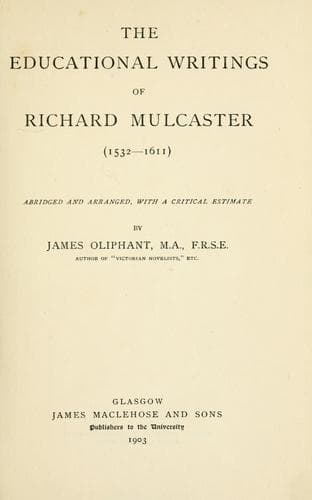
The Educational Writings of Richard MulcasterMulcaster, Richard
History
The Educational Writings of Richard Mulcaster
Mulcaster, Richard
Education -- History
It would not be difficult to show that many of the reforms which he
urged and anticipated, while they have been formally admitted as
necessary or expedient, have as yet made little way in leavening
the whole mass of educational practice. There is good reason
to maintain, for example, that the impartial diffusion of the
opportunities of learning throughout all classes of the community,
which was a fundamental part of Mulcaster’s gospel, has been much
less completely realised among us than is generally supposed. We
are apt to rest satisfied with the idea of universal education
without over-careful a scrutiny into the nature of what is offered
in its name. In so far as elementary instruction was concerned
Mulcaster drew no distinction between rich and poor, between those
of gentle and of lowly birth; all were to have the same treatment,
irrespective of the uses to which their knowledge might afterwards
be turned. Our State system of education may profess to carry out
this aim, but the justice of the claim must be denied so long as
the nature and quality of what is forcibly imposed upon the mass of
the people is seriously at fault. Our system of public elementary
education in this country, however efficiently it may be organised,
fails entirely to provide a sound general training owing to its
adoption of a curriculum that is unduly utilitarian in aim. It is
undeniable that this is largely due to an implicit caste feeling
which prescribes that the education of the masses shall fit them
directly for the performance of certain industrial tasks in a
state of economic subjection. The well-to-do citizen wishes his
own child, even from the first, to be taught differently from the
child of poorer parents, whose schooling he helps to pay for and
has some share in regulating. The course of study he chooses may be
no better,--in some respects it is undoubtedly worse; but at least
it is different, and conforms to the conventional standard of a
liberal training for life as a whole. The codes drawn up for our
national system are not framed for any such purpose. Partly from
ingrained class prejudice, partly to get tangible results to show
for the public money expended, and partly from a benevolent but
short-sighted regard for supposed utilities, we have overburdened
the curriculum with the more mechanical parts of learning. We put
too much of the drudgery into the years when we can make sure of
the children, so that a minimum of interest is taken in the work
for its own sake, with the result that when the compulsory term
is reached, the great majority of them use their liberty to throw
aside their books for ever. While this reproach remains just, can
we say that the ideal of a true universal elementary education has
yet been reached?
Public-domain text, read in full here on John Shaqi.
Reviews
Reviews
No reviews yet
Be the first to share your thoughts on this work.
Elsewhere in the archive
Join the Discussion
Join the discussion
Sign in to leave a comment or review.
Sign InorCreate an account