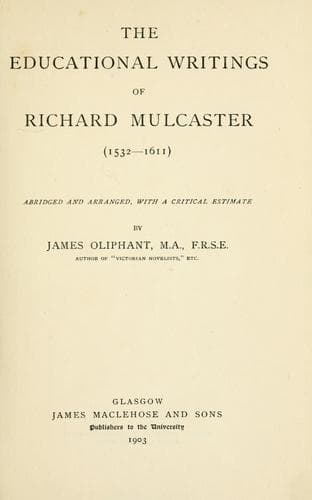
The Educational Writings of Richard MulcasterMulcaster, Richard
History
The Educational Writings of Richard Mulcaster
Mulcaster, Richard
Education -- History
It is perhaps idle to expect any equalisation of opportunities
by postponing every kind of specialism to a period beyond the
elementary stage, until there is a more general agreement as to
what constitutes a liberal education. If we apply the touchstone of
Mulcaster’s conception, how much of the traditional lumber which
is now obstructing our progress would have to be cleared away!
We are the bond-slaves of two tyrants--the spirit of an outworn
classicism and the spirit of a utilitarianism falsely so-called.
Under the domination of the former we distort the curriculum of
our higher-class schools, preparatory as well as secondary, by
projecting into the elementary period and practically imposing on
every scholar linguistic studies that should form a specialism only
for a very few during the later years of school life. Misguided by
the latter we debase our public primary education by filling up
the time with subjects of mere information that neither arouse the
interests of the learner nor afford a genuine mental discipline.
It would indeed astound the Elizabethan schoolmaster who tolerated
pre-occupation with the learned tongues only until his native
English should reach a high enough point of cultivation to become a
worthy receptacle of learning, and who lamented the temporary need
for a medium which kept the student “one degree further off from
knowledge” to find that after more than 300 years the shackles had
not yet been cast aside. Nor would he be less dismayed to discover
that the sole alternative offered to those who were excluded
from what professed to be a liberal culture, consisted only to a
very small extent of that direct knowledge of the facts and laws
of Nature which he conceived to be the proper food during “our
best learning time,” but mainly of the dry bones of second-hand
experience. Mulcaster’s ideal will not be attained until we have
devised a course of study up to the age of at least 14 or 15 years,
which shall form a preparation for life that is applicable to all
pupils alike--to boys and girls, to rich and poor, to those who can
pursue their systematic education further, and to those who must
discontinue it then to enter into the world of affairs.
Public-domain text, read in full here on John Shaqi.
Reviews
Reviews
No reviews yet
Be the first to share your thoughts on this work.
Elsewhere in the archive
Join the Discussion
Join the discussion
Sign in to leave a comment or review.
Sign InorCreate an account