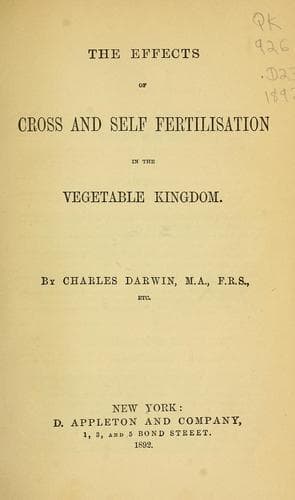
The Effects of Cross & Self-Fertilisation in the Vegetable KingdomDarwin, Charles
Science
The Effects of Cross & Self-Fertilisation in the Vegetable Kingdom
Darwin, Charles
Fertilization of plants; Plants -- Variation; Pollination
Andrew Knight saw the truth much more clearly, for he remarks, “Nature
intended that a sexual intercourse should take place between
neighbouring plants of the same species.” (1/5. ‘Philosophical
Transactions’ 1799 page 202.) After alluding to the various means by
which pollen is transported from flower to flower, as far as was then
imperfectly known, he adds, “Nature has something more in view than that
its own proper males would fecundate each blossom.” In 1811 Kolreuter
plainly hinted at the same law, as did afterwards another famous
hybridiser of plants, Herbert. (1/6. Kolreuter ‘Mem. de l’Acad. de St.
Petersbourg’ tome 3 1809 published 1811 page 197. After showing how well
the Malvaceae are adapted for cross-fertilisation, he asks, “An id
aliquid in recessu habeat, quod hujuscemodi flores nunquam proprio suo
pulvere, sed semper eo aliarum suae speciei impregnentur, merito
quaeritur? Certe natura nil facit frustra.” Herbert ‘Amaryllidaceae,
with a Treatise on Cross-bred Vegetables’ 1837.) But none of these
distinguished observers appear to have been sufficiently impressed with
the truth and generality of the law, so as to insist on it and impress
their beliefs on others.
In 1862 I summed up my observations on Orchids by saying that nature
“abhors perpetual self-fertilisation.” If the word perpetual had been
omitted, the aphorism would have been false. As it stands, I believe
that it is true, though perhaps rather too strongly expressed; and I
should have added the self-evident proposition that the propagation of
the species, whether by self-fertilisation or by cross-fertilisation, or
asexually by buds, stolons, etc. is of paramount importance. Hermann
Muller has done excellent service by insisting repeatedly on this latter
point.
It often occurred to me that it would be advisable to try whether
seedlings from cross-fertilised flowers were in any way superior to
those from self-fertilised flowers. But as no instance was known with
animals of any evil appearing in a single generation from the closest
possible interbreeding, that is between brothers and sisters, I thought
that the same rule would hold good with plants; and that it would be
necessary at the sacrifice of too much time to self-fertilise and
intercross plants during several successive generations, in order to
arrive at any result. I ought to have reflected that such elaborate
provisions favouring cross-fertilisation, as we see in innumerable
plants, would not have been acquired for the sake of gaining a distant
and slight advantage, or of avoiding a distant and slight evil.
Moreover, the fertilisation of a flower by its own pollen corresponds to
a closer form of interbreeding than is possible with ordinary bi-sexual
animals; so that an earlier result might have been expected.
Public-domain text, read in full here on John Shaqi.
Reviews
Reviews
No reviews yet
Be the first to share your thoughts on this work.
Join the Discussion
Join the discussion
Sign in to leave a comment or review.
Sign InorCreate an account