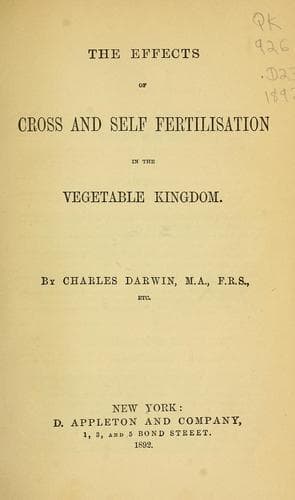
The Effects of Cross & Self-Fertilisation in the Vegetable KingdomDarwin, Charles
Science
The Effects of Cross & Self-Fertilisation in the Vegetable Kingdom
Darwin, Charles
Fertilization of plants; Plants -- Variation; Pollination
I was at last led to make the experiments recorded in the present volume
from the following circumstance. For the sake of determining certain
points with respect to inheritance, and without any thought of the
effects of close interbreeding, I raised close together two large beds
of self-fertilised and crossed seedlings from the same plant of Linaria
vulgaris. To my surprise, the crossed plants when fully grown were
plainly taller and more vigorous than the self-fertilised ones. Bees
incessantly visit the flowers of this Linaria and carry pollen from one
to the other; and if insects are excluded, the flowers produce extremely
few seeds; so that the wild plants from which my seedlings were raised
must have been intercrossed during all previous generations. It seemed
therefore quite incredible that the difference between the two beds of
seedlings could have been due to a single act of self-fertilisation; and
I attributed the result to the self-fertilised seeds not having been
well ripened, improbable as it was that all should have been in this
state, or to some other accidental and inexplicable cause. During the
next year, I raised for the same purpose as before two large beds close
together of self-fertilised and crossed seedlings from the carnation,
Dianthus caryophyllus. This plant, like the Linaria, is almost sterile
if insects are excluded; and we may draw the same inference as before,
namely, that the parent-plants must have been intercrossed during every
or almost every previous generation. Nevertheless, the self-fertilised
seedlings were plainly inferior in height and vigour to the crossed.
My attention was now thoroughly aroused, for I could hardly doubt that
the difference between the two beds was due to the one set being the
offspring of crossed, and the other of self-fertilised flowers.
Accordingly I selected almost by hazard two other plants, which happened
to be in flower in the greenhouse, namely, Mimulus luteus and Ipomoea
purpurea, both of which, unlike the Linaria and Dianthus, are highly
self-fertile if insects are excluded. Some flowers on a single plant of
both species were fertilised with their own pollen, and others were
crossed with pollen from a distinct individual; both plants being
protected by a net from insects. The crossed and self-fertilised seeds
thus produced were sown on opposite sides of the same pots, and treated
in all respects alike; and the plants when fully grown were measured and
compared. With both species, as in the cases of the Linaria and
Dianthus, the crossed seedlings were conspicuously superior in height
and in other ways to the self-fertilised. I therefore determined to
begin a long series of experiments with various plants, and these were
continued for the following eleven years; and we shall see that in a
large majority of cases the crossed beat the self-fertilised plants.
Several of the exceptional cases, moreover, in which the crossed plants
were not victorious, can be explained.
Public-domain text, read in full here on John Shaqi.
Reviews
Reviews
No reviews yet
Be the first to share your thoughts on this work.
Join the Discussion
Join the discussion
Sign in to leave a comment or review.
Sign InorCreate an account