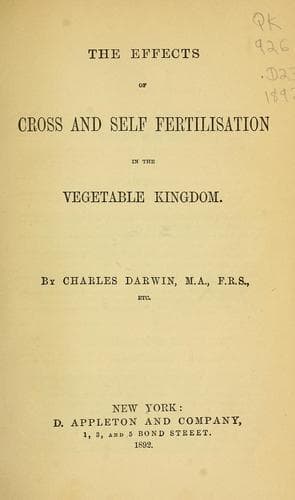
The Effects of Cross & Self-Fertilisation in the Vegetable KingdomDarwin, Charles
Science
The Effects of Cross & Self-Fertilisation in the Vegetable Kingdom
Darwin, Charles
Fertilization of plants; Plants -- Variation; Pollination
As only a moderate number of crossed and self-fertilised plants were
measured, it was of great importance to me to learn how far the averages
were trustworthy. I therefore asked Mr. Galton, who has had much
experience in statistical researches, to examine some of my tables of
measurements, seven in number, namely, those of Ipomoea, Digitalis,
Reseda lutea, Viola, Limnanthes, Petunia, and Zea. I may premise that if
we took by chance a dozen or score of men belonging to two nations and
measured them, it would I presume be very rash to form any judgment from
such small numbers on their average heights. But the case is somewhat
different with my crossed and self-fertilised plants, as they were of
exactly the same age, were subjected from first to last to the same
conditions, and were descended from the same parents. When only from two
to six pairs of plants were measured, the results are manifestly of
little or no value, except in so far as they confirm and are confirmed
by experiments made on a larger scale with other species. I will now
give the report on the seven tables of measurements, which Mr. Galton
has had the great kindness to draw up for me.
[“I have examined the measurements of the plants with care, and by many
statistical methods, to find out how far the means of the several sets
represent constant realities, such as would come out the same so long as
the general conditions of growth remained unaltered. The principal
methods that were adopted are easily explained by selecting one of the
shorter series of plants, say of Zea mays, for an example.”
TABLE 1/1. Zea mays (young plants). (Mr. Galton.)
Heights of Plants in inches:
Column 1: Number (Name) of Pot.
Column 2: Crossed, as recorded by Mr. Darwin.
Column 3: Self-fertilised, as recorded by Mr. Darwin.
Column 4: Crossed, in Separate Pots, arranged in order of magnitude.
Column 5: Self-fertilised, in Separate Pots, arranged in order of magnitude.
Column 6: Crossed, in a Single Series, arranged in order of magnitude.
Column 7: Self-fertilised, in a Single Series, arranged in order of
magnitude.
Column 8: Difference, in a Single Series, arranged in order of magnitude.
Pot 1 : 23 4/8 : 17 3/8 :: 23 4/8 : 20 3/8 :: 23 4/8 : 20 3/8 : -3 1/8.
Pot 1 : 12 : 20 3/8 :: 21 : 20 :: 23 2/8 : 20 : -3 2/8.
Pot 1 : 21 : 20 :: 12 : 17 3/8 :: 23 : 20 : -3.
Pot 1 : - : - :: - : - :: 22 1/8 : 18 5/8 : -3 4/8.
Pot 1 : 22 : 20 :: 22 : 20 :: 22 1/8 : 18 5/8 : -3 4/8.
Pot 2 : 19 1/8 : 18 3/8 :: 21 4/8 : 18 5/8 :: 22 : 18 3/8 : -3 5/8.
Pot 2 : 21 4/8 : 18 5/8 :: 19 1/8 : 18 3/8 :: 21 5/8 : 18 : -3 5/8.
Pot 2 : - : - :: - : - :: 21 4/8 : 18 : -3 4/8.
Pot 2 : 22 1/8 : 18 5/8 :: 23 2/8 : 18 5/8 :: 21 : 18 : -3.
Pot 2 : 20 3/8 : 15 2/8 :: 22 1/8 : 18 :: 21 : 17 3/8 : -3 5/8.
Public-domain text, read in full here on John Shaqi.
Reviews
Reviews
No reviews yet
Be the first to share your thoughts on this work.
Join the Discussion
Join the discussion
Sign in to leave a comment or review.
Sign InorCreate an account