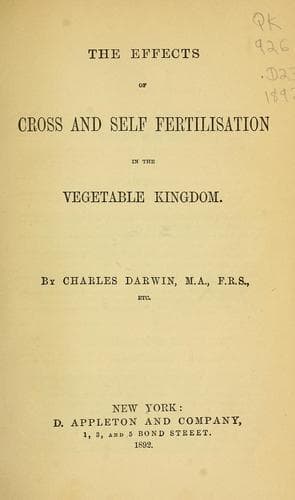
The Effects of Cross & Self-Fertilisation in the Vegetable KingdomDarwin, Charles
Science
The Effects of Cross & Self-Fertilisation in the Vegetable Kingdom
Darwin, Charles
Fertilization of plants; Plants -- Variation; Pollination
Pot 3 : 18 2/8 : 16 4/8 :: 21 5/8 : 16 4/8 :: 20 3/8 : 16 4/8 : -3 7/8.
Pot 3 : 21 5/8 : 18 :: 20 3/8 : 16 2/8 :: 19 1/8 : 16 2/8 : -2 7/8.
Pot 3 : 23 2/8 : 16 2/8 :: 18 2/8 : 15 2/8 :: 18 2/8 : 15 4/8 : -2 6/8.
Pot 3 : - : - :: - : - :: 12 : 15 2/8 : +3 2/8.
Pot 3 : 21 : 18 :: 23 : 18 :: 12 : 12 6/8 : +0 6/8.
Pot 4 : 22 1/8 : 12 6/8 :: 22 1/8 : 18.
Pot 4 : 23 : 15 4/8 :: 21 : 15 4/8.
Pot 4 : 12 : 18 :: 12 : 12 6/8.
“The observations as I received them are shown in Table 1/1, Columns 2
and 3, where they certainly have no prima facie appearance of
regularity. But as soon as we arrange them the in order of their
magnitudes, as in columns 4 and 5, the case is materially altered. We
now see, with few exceptions, that the largest plant on the crossed side
in each pot exceeds the largest plant on the self-fertilised side, that
the second exceeds the second, the third the third, and so on. Out of
the fifteen cases in the table, there are only two exceptions to this
rule. We may therefore confidently affirm that a crossed series will
always be found to exceed a self-fertilised series, within the range of
the conditions under which the present experiment has been made.”
TABLE 1/2.
Column 1: Number (Name) of Pot.
Column 2: Crossed.
Column 3: Self-fertilised.
Column 4: Difference.
Pot 1 : 18 7/8 : 19 2/8 : +0 3/8.
Pot 2 : 20 7/8 : 19 : -1 7/8.
Pot 3 : 21 1/8 : 16 7/8 : -4 2/8.
Pot 4 : 19 6/8 : 16 : -3 6/8.
“Next as regards the numerical estimate of this excess. The mean values
of the several groups are so discordant, as is shown in Table 1/2, that
a fairly precise numerical estimate seems impossible. But the
consideration arises, whether the difference between pot and pot may not
be of much the same order of importance as that of the other conditions
upon which the growth of the plants has been modified. If so, and only
on that condition, it would follow that when all the measurements,
either of the crossed or the self-fertilised plants, were combined into
a single series, that series would be statistically regular. The
experiment is tried in Table 1/1, columns 7 and 8, where the regularity
is abundantly clear, and justifies us in considering its mean as
perfectly reliable. I have protracted these measurements, and revised
them in the usual way, by drawing a curve through them with a free hand,
but the revision barely modifies the means derived from the original
observations. In the present, and in nearly all the other cases, the
difference between the original and revised means is under 2 per cent of
their value. It is a very remarkable coincidence that in the seven kinds
of plants, whose measurements I have examined, the ratio between the
heights of the crossed and of the self-fertilised ranges in five cases
within very narrow limits. In Zea mays it is as 100 to 84, and in the
others it ranges between 100 to 76 and 100 to 86.”
Public-domain text, read in full here on John Shaqi.
Reviews
Reviews
No reviews yet
Be the first to share your thoughts on this work.
Join the Discussion
Join the discussion
Sign in to leave a comment or review.
Sign InorCreate an account