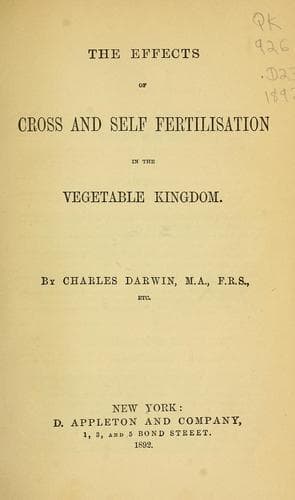
The Effects of Cross & Self-Fertilisation in the Vegetable Kingdom — John Shaqi
The Effects of Cross & Self-Fertilisation in the Vegetable KingdomDarwin, Charles
Science
The Effects of Cross & Self-Fertilisation in the Vegetable Kingdom
Darwin, Charles
Fertilization of plants; Plants -- Variation; Pollination
After the heights of the crossed and self-fertilised plants had been
taken, they were sometimes cut down close to the ground, and an equal
number of both weighed. This method of comparison gives very striking
results, and I wish that it had been oftener followed. Finally a record
was often kept of any marked difference in the rate of germination of
the crossed and self-fertilised seeds,--of the relative periods of
flowering of the plants raised from them,--and of their productiveness,
that is, of the number of seed-capsules which they produced and of the
average number of seeds which each capsule contained.
When I began my experiments I did not intend to raise crossed and
self-fertilised plants for more than a single generation; but as soon as
the plants of the first generation were in flower I thought that I would
raise one more generation, and acted in the following manner. Several
flowers on one or more of the self-fertilised plants were again
self-fertilised; and several flowers on one or more of the crossed
plants were fertilised with pollen from another crossed plant of the
same lot. Having thus once begun, the same method was followed for as
many as ten successive generations with some of the species. The seeds
and seedlings were always treated in exactly the same manner as already
described. The self-fertilised plants, whether originally descended from
one or two mother-plants, were thus in each generation as closely
interbred as was possible; and I could not have improved on my plan. But
instead of crossing one of the crossed plants with another crossed
plant, I ought to have crossed the self-fertilised plants of each
generation with pollen taken from a non-related plant--that is, one
belonging to a distinct family or stock of the same species and variety.
This was done in several cases as an additional experiment, and gave
very striking results. But the plan usually followed was to put into
competition and compare intercrossed plants, which were almost always
the offspring of more or less closely related plants, with the
self-fertilised plants of each succeeding generation;--all having been
grown under closely similar conditions. I have, however, learnt more by
this method of proceeding, which was begun by an oversight and then
necessarily followed, than if I had always crossed the self-fertilised
plants of each succeeding generation with pollen from a fresh stock.
Public-domain text, read in full here on John Shaqi.
Reviews
Reviews
No reviews yet
Be the first to share your thoughts on this work.
Join the Discussion
Join the discussion
Sign in to leave a comment or review.
Sign InorCreate an account