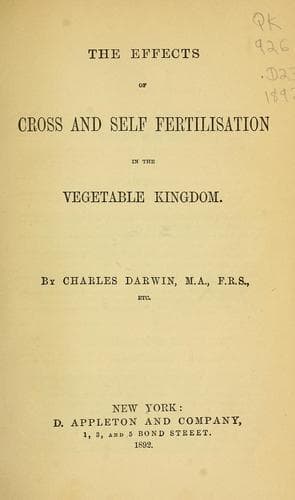
The Effects of Cross & Self-Fertilisation in the Vegetable Kingdom — John Shaqi
The Effects of Cross & Self-Fertilisation in the Vegetable KingdomDarwin, Charles
Science
The Effects of Cross & Self-Fertilisation in the Vegetable Kingdom
Darwin, Charles
Fertilization of plants; Plants -- Variation; Pollination
I have said that the crossed plants of the successive generations were
almost always inter-related. When the flowers on an hermaphrodite plant
are crossed with pollen taken from a distinct plant, the seedlings thus
raised may be considered as hermaphrodite brothers or sisters; those
raised from the same capsule being as close as twins or animals of the
same litter. But in one sense the flowers on the same plant are distinct
individuals, and as several flowers on the mother-plant were crossed by
pollen taken from several flowers on the father-plant, such seedlings
would be in one sense half-brothers or sisters, but more closely related
than are the half-brothers and sisters of ordinary animals. The flowers
on the mother-plant were, however, commonly crossed by pollen taken from
two or more distinct plants; and in these cases the seedlings might be
called with more truth half-brothers or sisters. When two or three
mother-plants were crossed, as often happened, by pollen taken from two
or three father-plants (the seeds being all intermingled), some of the
seedlings of the first generation would be in no way related, whilst
many others would be whole or half-brothers and sisters. In the second
generation a large number of the seedlings would be what may be called
whole or half first-cousins, mingled with whole and half-brothers and
sisters, and with some plants not at all related. So it would be in the
succeeding generations, but there would also be many cousins of the
second and more remote degrees. The relationship will thus have become
more and more inextricably complex in the later generations; with most
of the plants in some degree and many of them closely related.
I have only one other point to notice, but this is one of the highest
importance; namely, that the crossed and self-fertilised plants were
subjected in the same generation to as nearly similar and uniform
conditions as was possible. In the successive generations they were
exposed to slightly different conditions as the seasons varied, and they
were raised at different periods. But in other respects all were treated
alike, being grown in pots in the same artificially prepared soil, being
watered at the same time, and kept close together in the same greenhouse
or hothouse. They were therefore not exposed during successive years to
such great vicissitudes of climate as are plants growing out of doors.
ON SOME APPARENT AND REAL CAUSES OF ERROR IN MY EXPERIMENTS.
Public-domain text, read in full here on John Shaqi.
Reviews
Reviews
No reviews yet
Be the first to share your thoughts on this work.
Join the Discussion
Join the discussion
Sign in to leave a comment or review.
Sign InorCreate an account