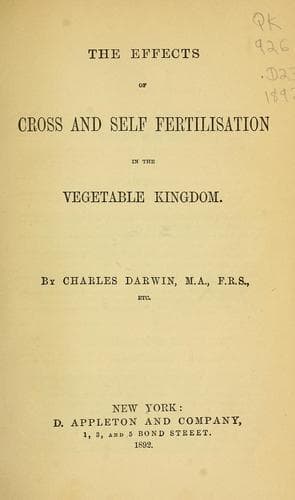
The Effects of Cross & Self-Fertilisation in the Vegetable KingdomDarwin, Charles
Science
The Effects of Cross & Self-Fertilisation in the Vegetable Kingdom
Darwin, Charles
Fertilization of plants; Plants -- Variation; Pollination
stock.
This species offers another interesting case. In the five first
generations in which intercrossed and self-fertilised plants were put
into competition with one another, every single intercrossed plant beat
its self-fertilised antagonist, except in one instance, in which they
were equal in height. But in the sixth generation a plant appeared,
named by me the Hero, remarkable for its tallness and increased
self-fertility, and which transmitted its characters to the next three
generations. The children of Hero were again self-fertilised, forming
the eighth self-fertilised generation, and were likewise intercrossed
one with another; but this cross between plants which had been subjected
to the same conditions and had been self-fertilised during the seven
previous generations, did not effect the least good; for the
intercrossed grandchildren were actually shorter than the
self-fertilised grandchildren, in the ratio of 100 to 107. We here see
that the mere act of crossing two distinct plants does not by itself
benefit the offspring. This case is almost the converse of that in the
last paragraph, on which the offspring profited so greatly by a cross
with a fresh stock. A similar trial was made with the descendants of
Hero in the following generation, and with the same result. But the
trial cannot be fully trusted, owing to the extremely unhealthy
condition of the plants. Subject to this same serious cause of doubt,
even a cross with a fresh stock did not benefit the great-grandchildren
of Hero; and if this were really the case, it is the greatest anomaly
observed by me in all my experiments.
2. Mimulus luteus.
During the three first generations the intercrossed plants taken
together exceeded in height the self-fertilised taken together, in the
ratio of 100 to 65, and in fertility in a still higher degree. In the
fourth generation a new variety, which grew taller and had whiter and
larger flowers than the old varieties, began to prevail, especially
amongst the self-fertilised plants. This variety transmitted its
characters with remarkable fidelity, so that all the plants in the later
self-fertilised generations belonged to it. These consequently exceeded
the intercrossed plants considerably in height. Thus in the seventh
generation the intercrossed plants were to the self-fertilised in height
as 100 to 137. It is a more remarkable fact that the self-fertilised
plants of the sixth generation had become much more fertile than the
intercrossed plants, judging by the number of capsules spontaneously
produced, in the ratio of 147 to 100. This variety, which as we have
seen appeared amongst the plants of the fourth self-fertilised
generation, resembles in almost all its constitutional peculiarities the
variety called Hero which appeared in the sixth self-fertilised
generation of Ipomoea. No other such case, with the partial exception of
that of Nicotiana, occurred in my experiments, carried on during eleven
years.
Public-domain text, read in full here on John Shaqi.
Reviews
Reviews
No reviews yet
Be the first to share your thoughts on this work.
Elsewhere in the archive
Join the Discussion
Join the discussion
Sign in to leave a comment or review.
Sign InorCreate an account