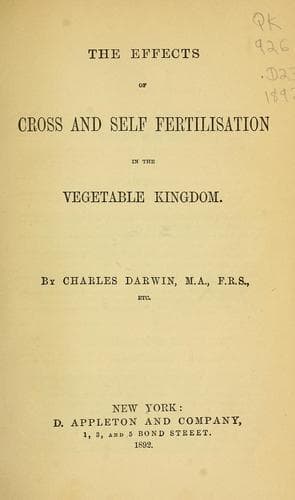
The Effects of Cross & Self-Fertilisation in the Vegetable KingdomDarwin, Charles
Science
The Effects of Cross & Self-Fertilisation in the Vegetable Kingdom
Darwin, Charles
Fertilization of plants; Plants -- Variation; Pollination
Two plants of this variety of Mimulus, belonging to the sixth
self-fertilised generation, and growing in separate pots, were
intercrossed; and some flowers on the same plants were again
self-fertilised. From the seeds thus obtained, plants derived from a
cross between the self-fertilised plants, and others of the seventh
self-fertilised generation, were raised. But this cross did not do the
least good, the intercrossed plants being inferior in height to the
self-fertilised, in the ratio of 100 to 110. This case is exactly
parallel with that given under Ipomoea, of the grandchildren of Hero,
and apparently of its great-grandchildren; for the seedlings raised by
intercrossing these plants were not in any way superior to those of the
corresponding generation raised from the self-fertilised flowers.
Therefore in these several cases the crossing of plants, which had been
self-fertilised for several generations and which had been cultivated
all the time under as nearly as possible the same conditions, was not in
the least beneficial.
Another experiment was now tried. Firstly, plants of the eighth
self-fertilised generation were again self-fertilised, producing plants
of the ninth self-fertilised generation. Secondly, two of the plants of
the eighth self-fertilised generation were intercrossed one with
another, as in the experiment above referred to; but this was now
effected on plants which had been subjected to two additional
generations of self-fertilisation. Thirdly, the same plants of the
eighth self-fertilised generation were crossed with pollen from plants
of a fresh stock brought from a distant garden. Numerous plants were
raised from these three sets of seeds, and grown in competition with one
another. The plants derived from a cross between the self-fertilised
plants exceeded in height by a little the self-fertilised, namely, as
100 to 92; and in fertility in a greater degree, namely, as 100 to 73. I
do not know whether this difference in the result, compared with that in
the previous case, can be accounted for by the increased deterioration
of the self-fertilised plants from two additional generations of
self-fertilisation, and the consequent advantage of any cross whatever,
along merely between the self-fertilised plants. But however this may
be, the effects of crossing the self-fertilised plants of the eighth
generation with a fresh stock were extremely striking; for the seedlings
thus raised were to the self-fertilised of the ninth generation as 100
to 52 in height, and as 100 to 3 in fertility! They were also to the
intercrossed plants (derived from crossing two of the self-fertilised
plants of the eighth generation) in height as 100 to 56, and in
fertility as 100 to 4. Better evidence could hardly be desired of the
potent influence of a cross with a fresh stock on plants which had been
self-fertilised for eight generations, and had been cultivated all the
time under nearly uniform conditions, in comparison with plants
Public-domain text, read in full here on John Shaqi.
Reviews
Reviews
No reviews yet
Be the first to share your thoughts on this work.
Elsewhere in the archive
Join the Discussion
Join the discussion
Sign in to leave a comment or review.
Sign InorCreate an account