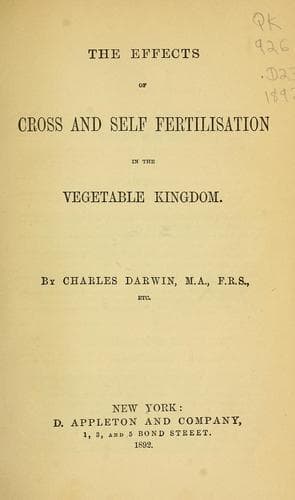
The Effects of Cross & Self-Fertilisation in the Vegetable KingdomDarwin, Charles
Science
The Effects of Cross & Self-Fertilisation in the Vegetable Kingdom
Darwin, Charles
Fertilization of plants; Plants -- Variation; Pollination
Some flowers on long-styled plants of the third illegitimate generation
were legitimately crossed with pollen from a fresh stock, and others
were fertilised with their own pollen. From the seeds thus produced
crossed plants, and self-fertilised plants of the fourth illegitimate
generation, were raised. The former were to the latter in height as 100
to 46, and in fertility during one year as 100 to 5, and as 100 to 3.5
during the next year. In this case, however, we have no means of
distinguishing between the evil effects of illegitimate fertilisation
continued during four generations (that is, by pollen of the same form,
but taken from a distinct plant) and strict self-fertilisation. But it
is probable that these two processes do not differ so essentially as at
first appears to be the case. In the following experiment any doubt
arising from illegitimate fertilisation was completely eliminated.
13. Primula veris. (Equal-styled, red-flowered variety.)
Flowers on plants of the second self-fertilised generation were crossed
with pollen from a distinct variety or fresh stock, and others were
again self-fertilised. Crossed plants and plants of the third
self-fertilised generation, all of legitimate origin, were thus raised;
and the former was to the latter in height as 100 to 85, and in
fertility (as judged by the number of capsules produced, together with
the average number of seeds) as 100 to 11.
SUMMARY OF THE MEASUREMENTS IN TABLE 7/C.
This table includes the heights and often the weights of 292 plants
derived from a cross with a fresh stock, and of 305 plants, either of
self-fertilised origin, or derived from an intercross between plants of
the same stock. These 597 plants belong to thirteen species and twelve
genera. The various precautions which were taken to ensure a fair
comparison have already been stated. If we now look down the right hand
column, in which the mean height, weight, and fertility of the plants
derived from a cross with a fresh stock are represented by 100, we shall
see by the other figures how wonderfully superior they are both to the
self-fertilised and to the intercrossed plants of the same stock. With
respect to height and weight, there are only two exceptions to the rule,
namely, with Eschscholtzia and Petunia, and the latter is probably no
real exception. Nor do these two species offer an exception in regard to
fertility, for the plants derived from the cross with a fresh stock were
much more fertile than the self-fertilised plants. The difference
between the two sets of plants in the table is generally much greater in
fertility than in height or weight. On the other hand, with some of the
species, as with Nicotiana, there was no difference in fertility between
the two sets, although a great difference in height and weight.
Considering all the cases in this table, there can be no doubt that
plants profit immensely, though in different ways, by a cross with a
fresh stock or with a distinct sub-variety.
Public-domain text, read in full here on John Shaqi.
Reviews
Reviews
No reviews yet
Be the first to share your thoughts on this work.
Elsewhere in the archive
Join the Discussion
Join the discussion
Sign in to leave a comment or review.
Sign InorCreate an account