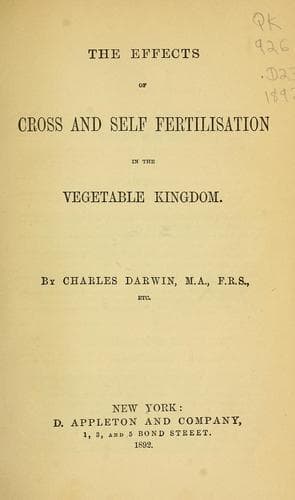
The Effects of Cross & Self-Fertilisation in the Vegetable KingdomDarwin, Charles
Science
The Effects of Cross & Self-Fertilisation in the Vegetable Kingdom
Darwin, Charles
Fertilization of plants; Plants -- Variation; Pollination
Deducting these fourteen cases, there remain twelve in which the crossed
plants show no well-marked advantage over the self-fertilised. On the
other hand, we have seen that there are fifty-seven cases in which the
crossed plants exceed the self-fertilised in height by at least five per
cent, and generally in a much higher degree. But even in the twelve
cases just referred to, the want of any advantage on the crossed side is
far from certain: with Thunbergia the parent-plants were in an odd
semi-sterile condition, and the offspring grew very unequally; with
Hibiscus and Apium much too few plants were raised for the measurements
to be trusted, and the cross-fertilised flowers of Hibiscus produced
rather more seed than did the self-fertilised; with Vandellia the
crossed plants were a little taller and heavier than the
self-fertilised, but as they were less fertile the case must be left
doubtful. Lastly, with Pisum, Primula, the three generations of Canna,
and the three of Nicotiana (which together complete the twelve cases), a
cross between two plants certainly did no good or very little good to
the offspring; but we have reason to believe that this is the result of
these plants having been self-fertilised and cultivated under nearly
uniform conditions for several generations. The same result followed
with the experimental plants of Ipomoea and Mimulus, and to a certain
extent with some other species, which had been intentionally treated by
me in this manner; yet we know that these species in their normal
condition profit greatly by being intercrossed. There is, therefore, not
a single case in Table 7/A which affords decisive evidence against the
rule that a cross between plants, the progenitors of which have been
subjected to somewhat diversified conditions, is beneficial to the
offspring. This is a surprising conclusion, for from the analogy of
domesticated animals it could not have been anticipated, that the good
effects of crossing or the evil effects of self-fertilisation would have
been perceptible until the plants had been thus treated for several
generations.
The results given in Table 7/A may be looked at under another point of
view. Hitherto each generation has been considered as a separate case,
of which there are eighty-three; and this no doubt is the more correct
method of comparing the crossed and self-fertilised plants.
Public-domain text, read in full here on John Shaqi.
Reviews
Reviews
No reviews yet
Be the first to share your thoughts on this work.
Elsewhere in the archive
Join the Discussion
Join the discussion
Sign in to leave a comment or review.
Sign InorCreate an account