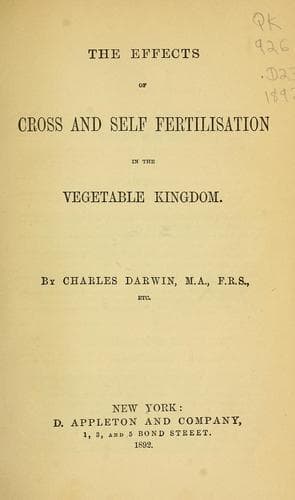
The Effects of Cross & Self-Fertilisation in the Vegetable KingdomDarwin, Charles
Science
The Effects of Cross & Self-Fertilisation in the Vegetable Kingdom
Darwin, Charles
Fertilization of plants; Plants -- Variation; Pollination
But in those cases in which plants of the same species were observed
during several generations, a general average of their heights in all
the generations together may be made; and such averages are given in
Table 7/A; for instance, under Ipomoea the general average for the
plants of all ten generations is as 100 for the crossed, to 77 for the
self-fertilised plants. This having been done in each case in which more
than one generation was raised, it is easy to calculate the average of
the average heights of the crossed and self-fertilised plants of all the
species included in Table 7/A. It should however be observed that as
only a few plants of some species, whilst a considerable number of
others, were measured, the value of the mean or average heights of the
several species is very different. Subject to this source of error, it
may be worth while to give the mean of the mean heights of the
fifty-four species in Table 7/A; and the result is, calling the mean of
the mean heights of the crossed plants 100, that of the self-fertilised
plants is 87. But it is a better plan to divide the fifty-four species
into three groups, as was done with the previously given eighty-three
cases. The first group consists of species of which the mean heights of
the self-fertilised plants are within five per cent of 100; so that the
crossed and self-fertilised plants are approximately equal; and of such
species there are twelve about which nothing need be said, the mean of
the mean heights of the self-fertilised being of course very nearly 100,
or exactly 99.58. The second group consists of the species, thirty-seven
in number, of which the mean heights of the crossed plants exceed that
of the self-fertilised plants by more than five per cent; and the mean
of their mean heights is to that of the self-fertilised plants as 100 to
78. The third group consists of the species, only five in number, of
which the mean heights of the self-fertilised plants exceed that of the
crossed by more than five per cent; and here the mean of the mean
heights of the crossed plants is to that of the self-fertilised as 100
to 109. Therefore if we exclude the species which are approximately
equal, there are thirty-seven species in which the mean of the mean
heights of the crossed plants exceeds that of the self-fertilised by
twenty-two per cent; whereas there are only five species in which the
mean of the mean heights of the self-fertilised plants exceeds that of
the crossed, and this only by nine per cent.
Public-domain text, read in full here on John Shaqi.
Reviews
Reviews
No reviews yet
Be the first to share your thoughts on this work.
Elsewhere in the archive
Join the Discussion
Join the discussion
Sign in to leave a comment or review.
Sign InorCreate an account