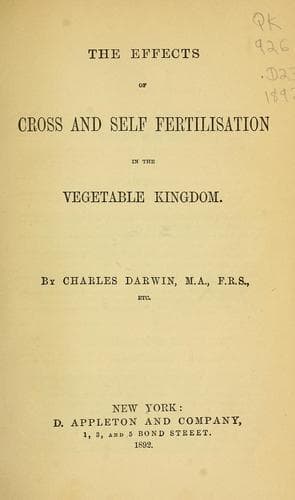
The Effects of Cross & Self-Fertilisation in the Vegetable KingdomDarwin, Charles
Science
The Effects of Cross & Self-Fertilisation in the Vegetable Kingdom
Darwin, Charles
Fertilization of plants; Plants -- Variation; Pollination
The truth of the conclusion--that the good effects of a cross depend on
the plants having been subjected to different conditions or to their
belonging to different varieties, in both of which cases they would
almost certainly differ somewhat in constitution--is supported by a
comparison of the Tables 7/A and 7/C. The latter table gives the results
of crossing plants with a fresh stock or with a distinct variety; and
the superiority of the crossed offspring over the self-fertilised is
here much more general and much more strongly marked than in Table 7/A,
in which plants of the same stock were crossed. We have just seen that
the mean of the mean heights of the crossed plants of the whole
fifty-four species in Table 7/A is to that of the self-fertilised plants
as 100 to 87; whereas the mean of the mean heights of the plants crossed
by a fresh stock is to that of the self-fertilised in Table 7/C as 100
to 74. So that the crossed plants beat the self-fertilised plants by
thirteen per cent in Table 7/A, and by twenty-six per cent, or double as
much, in Table 7/C, which includes the results of the cross by a fresh
stock.
TABLE 7/B.
A few words must be added on the weights of the crossed plants of the
same stock, in comparison with the self-fertilised. Eleven cases are
given in Table 7/B, relating to eight species. The number of plants
which were weighed is shown in the two left columns, and their relative
weights in the right column, that of the crossed plants being taken as
100. A few other cases have already been recorded in Table 7/C in
reference to plants crossed by a fresh stock. I regret that more trials
of this kind were not made, as the evidence of the superiority of the
crossed over the self-fertilised plants is thus shown in a more
conclusive manner than by their relative heights. But this plan was not
thought of until a rather late period, and there were difficulties
either way, as the seeds had to be collected when ripe, by which time
the plants had often begun to wither. In only one out of the eleven
cases in Table 7/B, that of Eschscholtzia, do the self-fertilised plants
exceed the crossed in weight; and we have already seen they are likewise
superior to them in height, though inferior in fertility, the whole
advantage of a cross being here confined to the reproductive system.
With Vandellia the crossed plants were a little heavier, as they were
also a little taller than the self-fertilised; but as a greater number
of more productive capsules were produced by the cleistogene flowers on
the self-fertilised plants than by those on the crossed plants, the case
must be left, as remarked under Table 7/A, altogether doubtful. The
crossed and self-fertilised offspring from a partially self-sterile
plant of Reseda odorata were almost equal in weight, though not in
height. In the remaining eight cases, the crossed plants show a
wonderful superiority over the self-fertilised, being more than double
Public-domain text, read in full here on John Shaqi.
Reviews
Reviews
No reviews yet
Be the first to share your thoughts on this work.
Elsewhere in the archive
Join the Discussion
Join the discussion
Sign in to leave a comment or review.
Sign InorCreate an account