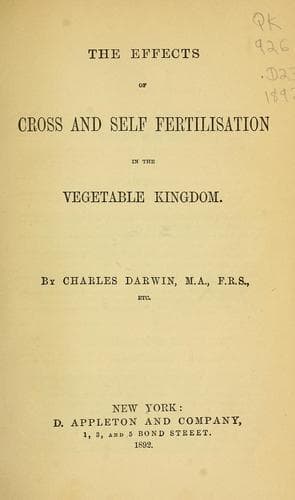
The Effects of Cross & Self-Fertilisation in the Vegetable KingdomDarwin, Charles
Science
The Effects of Cross & Self-Fertilisation in the Vegetable Kingdom
Darwin, Charles
Fertilization of plants; Plants -- Variation; Pollination
their weight, except in one case, and here the ratio is as high as 100
to 67. The results thus deduced from the weights of the plants confirm
in a striking manner the former evidence of the beneficial effects of a
cross between two plants of the same stock; and in the few cases in
which plants derived from a cross with a fresh stock were weighed, the
results are similar or even more striking.
CHAPTER VIII.
DIFFERENCE BETWEEN CROSSED AND SELF-FERTILISED PLANTS IN CONSTITUTIONAL
VIGOUR AND IN OTHER RESPECTS.
Greater constitutional vigour of crossed plants.
The effects of great crowding.
Competition with other kinds of plants.
Self-fertilised plants more liable to premature death.
Crossed plants generally flower before the self-fertilised.
Negative effects of intercrossing flowers on the same plant.
Cases described.
Transmission of the good effects of a cross to later generations.
Effects of crossing plants of closely related parentage.
Uniform colour of the flowers on plants self-fertilised during several
generations and cultivated under similar conditions.
GREATER CONSTITUTIONAL VIGOUR OF CROSSED PLANTS.
As in almost all my experiments an equal number of crossed and
self-fertilised seeds, or more commonly seedlings just beginning to
sprout, were planted on the opposite sides of the same pots, they had to
compete with one another; and the greater height, weight, and fertility
of the crossed plants may be attributed to their possessing greater
innate constitutional vigour. Generally the plants of the two lots
whilst very young were of equal height; but afterwards the crossed
gained insensibly on their opponents, and this shows that they possessed
some inherent superiority, though not displayed at a very early period
in life. There were, however, some conspicuous exceptions to the rule of
the two lots being at first equal in height; thus the crossed seedlings
of the broom (Sarothamnus scoparius) when under three inches in height
were more than twice as tall as the self-fertilised plants.
Public-domain text, read in full here on John Shaqi.
Reviews
Reviews
No reviews yet
Be the first to share your thoughts on this work.
Elsewhere in the archive
Join the Discussion
Join the discussion
Sign in to leave a comment or review.
Sign InorCreate an account