The Effects of Cross & Self-Fertilisation in the Vegetable KingdomDarwin, Charles
Science
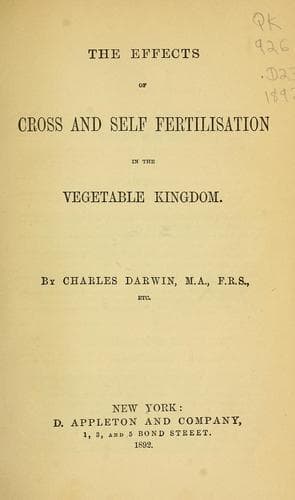
The Effects of Cross & Self-Fertilisation in the Vegetable Kingdom
Darwin, Charles
Fertilization of plants; Plants -- Variation; Pollination
After the crossed or the self-fertilised plants had once grown decidedly
taller than their opponents, a still increasing advantage would tend to
follow from the stronger plants robbing the weaker ones of nourishment
and overshadowing them. This was evidently the case with the crossed
plants of Viola tricolor, which ultimately quite overwhelmed the
self-fertilised. But that the crossed plants have an inherent
superiority, independently of competition, was sometimes well shown when
both lots were planted separately, not far distant from one another, in
good soil in the open ground. This was likewise shown in several cases,
even with plants growing in close competition with one another, by one
of the self-fertilised plants exceeding for a time its crossed opponent,
which had been injured by some accident or was at first sickly, but
being ultimately conquered by it. The plants of the eighth generation of
Ipomoea were raised from small seeds produced by unhealthy parents, and
the self-fertilised plants grew at first very rapidly, so that when the
plants of both lots were about three feet in height, the mean height of
the crossed to that of the self-fertilised was as 100 to 122; when they
were about six feet high the two lots were very nearly equal, but
ultimately when between eight and nine feet in height, the crossed
plants asserted their usually superiority, and were to the
self-fertilised in height as 100 to 85.
The constitutional superiority of the crossed over the self-fertilised
plants was proved in another way in the third generation of Mimulus, by
self-fertilised seeds being sown on one side of a pot, and after a
certain interval of time crossed seeds on the opposite side. The
self-fertilised seedlings thus had (for I ascertained that the seeds
germinated simultaneously) a clear advantage over the crossed in the
start for the race. Nevertheless they were easily beaten (as may be seen
under the head of Mimulus) when the crossed seeds were sown two whole
days after the self-fertilised. But when the interval was four days, the
two lots were nearly equal throughout life. Even in this latter case the
crossed plants still possessed an inherent advantage, for after both
lots had grown to their full height they were cut down, and without
being disturbed were transferred to a larger pot, and when in the
ensuing year they had again grown to their full height they were
measured; and now the tallest crossed plants were to the tallest
self-fertilised plants in height as 100 to 75, and in fertility (i.e.,
by weight of seeds produced by an equal number of capsules from both
lots) as 100 to 34.
Public-domain text, read in full here on John Shaqi.
Reviews
Reviews
No reviews yet
Be the first to share your thoughts on this work.
Elsewhere in the archive
Join the Discussion
Join the discussion
Sign in to leave a comment or review.
Sign InorCreate an account