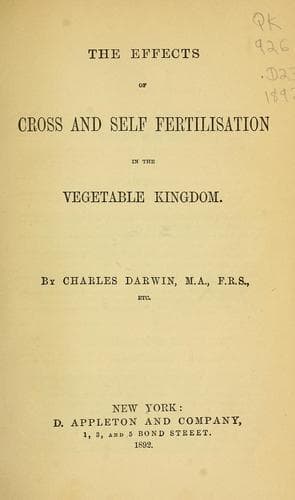
The Effects of Cross & Self-Fertilisation in the Vegetable KingdomDarwin, Charles
Science
The Effects of Cross & Self-Fertilisation in the Vegetable Kingdom
Darwin, Charles
Fertilization of plants; Plants -- Variation; Pollination
A consideration of the two first lists, especially of the second one,
shows that a tendency to flower first is generally connected with
greater power of growth, that is, with greater height. But there are
some remarkable exceptions to this rule, proving that some other cause
comes into play. Thus the crossed plants both of Lupinus luteus and
Clarkia elegans were to the self-fertilised plants in height as 100 to
82, and yet the latter flowered first. In the third generation of
Nicotiana, and in all three generations of Canna, the crossed and
self-fertilised plants were of nearly equal height, yet the
self-fertilised tended to flower first. On the other hand, with Primula
sinensis, plants raised from a cross between two distinct individuals,
whether these were legitimately or illegitimately crossed, flowered
before the illegitimately self-fertilised plants, although all the
plants were of nearly equal height in both cases. So it was with respect
to height and flowering with Phaseolus, Specularia, and Borago. The
crossed plants of Hibiscus were inferior in height to the
self-fertilised, in the ratio of 100 to 109, and yet they flowered
before the self-fertilised in three out of the four pots. On the whole,
there can be no doubt that the crossed plants exhibit a tendency to
flower before the self-fertilised, almost though not quite so strongly
marked as to grow to a greater height, to weigh more, and to be more
fertile.
A few other cases not included in the above three lists deserve notice.
In all three pots of Viola tricolor, naturally crossed plants the
offspring of crossed plants flowered before naturally crossed plants the
offspring of self-fertilised plants. Flowers on two plants, both of
self-fertilised parentage, of the sixth generation of Mimulus luteus
were intercrossed, and other flowers on the same plants were fertilised
with their own pollen; intercrossed seedlings and seedlings of the
seventh self-fertilised generation were thus raised, and the latter
flowered before the intercrossed in three out of the five pots. Flowers
on a plant both of Mimulus luteus and of Ipomoea purpurea were crossed
with pollen from other flowers on the same plant, and other flowers were
fertilised with their own pollen; intercrossed seedlings of this
peculiar kind, and others strictly self-fertilised being thus raised. In
the case of the Mimulus the self-fertilised plants flowered first in
seven out of the eight pots, and in the case of the Ipomoea in eight out
of the ten pots; so that an intercross between the flowers on the same
plant was very far from giving to the offspring thus raised, any
advantage over the strictly self-fertilised plants in their period of
flowering.
EFFECTS OF CROSSING FLOWERS ON THE SAME PLANT.
Public-domain text, read in full here on John Shaqi.
Reviews
Reviews
No reviews yet
Be the first to share your thoughts on this work.
Elsewhere in the archive
Join the Discussion
Join the discussion
Sign in to leave a comment or review.
Sign InorCreate an account