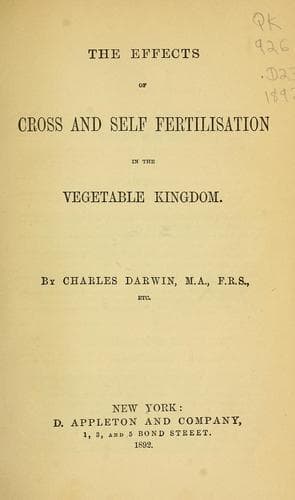
The Effects of Cross & Self-Fertilisation in the Vegetable KingdomDarwin, Charles
Science
The Effects of Cross & Self-Fertilisation in the Vegetable Kingdom
Darwin, Charles
Fertilization of plants; Plants -- Variation; Pollination
In the discussion on the results of a cross with a fresh stock, given
under Table 7/C in the last chapter, it was shown that the mere act of
crossing by itself does no good; but that the advantages thus derived
depend on the plants which are crossed, either consisting of distinct
varieties which will almost certainly differ somewhat in constitution,
or on the progenitors of the plants which are crossed, though identical
in every external character, having been subjected to somewhat different
conditions and having thus acquired some slight difference in
constitution. All the flowers produced by the same plant have been
developed from the same seed; those which expand at the same time have
been exposed to exactly the same climatic influences; and the stems have
all been nourished by the same roots. Therefore in accordance with the
conclusion just referred to, no good ought to result from crossing
flowers on the same plant. (8/1. It is, however, possible that the
stamens which differ in length or construction in the same flower may
produce pollen differing in nature, and in this manner a cross might be
made effective between the several flowers on the same plant. Mr. Macnab
states in a communication to M. Verlot ‘La Production des Varietes’ 1865
page 42, that seedlings raised from the shorter and longer stamens of
rhododendron differ in character; but the shorter stamens apparently are
becoming rudimentary, and the seedlings are dwarfs, so that the result
may be simply due to a want of fertilising power in the pollen, as in
the case of the dwarfed plants of Mirabilis raised by Naudin by the use
of too few pollen-grains. Analogous statements have been made with
respect to the stamens of Pelargonium. With some of the Melastomaceae,
seedlings raised by me from flowers fertilised by pollen from the
shorter stamens, certainly differed in appearance from those raised from
the longer stamens, with differently coloured anthers; but here, again,
there is some reason for believing that the shorter stamens are tending
towards abortion. In the very different case of trimorphic heterostyled
plants, the two sets of stamens in the same flower have widely different
fertilising powers.) In opposition to this conclusion is the fact that a
bud is in one sense a distinct individual, and is capable of
occasionally or even not rarely assuming new external characters, as
well as new constitutional peculiarities. Plants raised from buds which
have thus varied may be propagated for a great length of time by grafts,
cuttings, etc., and sometimes even by seminal generation. (8/2. I have
given numerous cases of such bud-variations in my ‘Variation of Animals
and Plants under Domestication’ chapter 11 2nd edition volume 1 page
448.) There exist also numerous species in which the flowers on the same
plant differ from one another,--as in the sexual organs of monoecious
and polygamous plants,--in the structure of the circumferential flowers
Public-domain text, read in full here on John Shaqi.
Reviews
Reviews
No reviews yet
Be the first to share your thoughts on this work.
Elsewhere in the archive
Join the Discussion
Join the discussion
Sign in to leave a comment or review.
Sign InorCreate an account