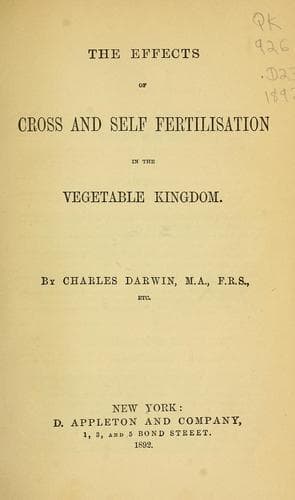
The Effects of Cross & Self-Fertilisation in the Vegetable KingdomDarwin, Charles
Science
The Effects of Cross & Self-Fertilisation in the Vegetable Kingdom
Darwin, Charles
Fertilization of plants; Plants -- Variation; Pollination
in many Compositae, Umbelliferae, etc.,--in the structure of the central
flower in some plants,--in the two kinds of flowers produced by
cleistogene species,--and in several other such cases. These instances
clearly prove that the flowers on the same plant have often varied
independently of one another in many important respects, such variations
having been fixed, like those on distinct plants during the development
of species.
It was therefore necessary to ascertain by experiment what would be the
effect of intercrossing flowers on the same plant, in comparison with
fertilising them with their own pollen or crossing them with pollen from
a distinct plant. Trials were carefully made on five genera belonging to
four families; and in only one case, namely, Digitalis, did the
offspring from a cross between the flowers on the same plant receive any
benefit, and the benefit here was small compared with that derived from
a cross between distinct plants. In the chapter on Fertility, when we
consider the effects of cross-fertilisation and self-fertilisation on
the productiveness of the parent-plants we shall arrive at nearly the
same result, namely, that a cross between the flowers on the same plant
does not at all increase the number of the seeds, or only occasionally
and to a slight degree. I will now give an abstract of the results of
the five trials which were made.
1. Digitalis purpurea.
Seedlings raised from intercrossed flowers on the same plant, and others
from flowers fertilised with their own pollen, were grown in the usual
manner in competition with one another on the opposite sides of ten
pots. In this and the four following cases, the details may be found
under the head of each species. In eight pots, in which the plants did
not grow much crowded, the flower-stems on sixteen intercrossed plants
were in height to those on sixteen self-fertilised plants, as 100 to 94.
In the two other pots on which the plants grew much crowded, the
flower-stems on nine intercrossed plants were in height to those on nine
self-fertilised plants, as 100 to 90. That the intercrossed plants in
these two latter pots had a real advantage over their self-fertilised
opponents, was well shown by their relative weights when cut down, which
was as 100 to 78. The mean height of the flower-stems on the twenty-five
intercrossed plants in the ten pots taken together, was to that of the
flower-stems on the twenty-five self-fertilised plants, as 100 to 92.
Thus the intercrossed plants were certainly superior to the
self-fertilised in some degree; but their superiority was small compared
with that of the offspring from a cross between distinct plants over the
self-fertilised, this being in the ratio of 100 to 70 in height. Nor
does this latter ratio show at all fairly the great superiority of the
plants derived from a cross between distinct individuals over the
self-fertilised, as the former produced more than twice as many
Public-domain text, read in full here on John Shaqi.
Reviews
Reviews
No reviews yet
Be the first to share your thoughts on this work.
Elsewhere in the archive
Join the Discussion
Join the discussion
Sign in to leave a comment or review.
Sign InorCreate an account