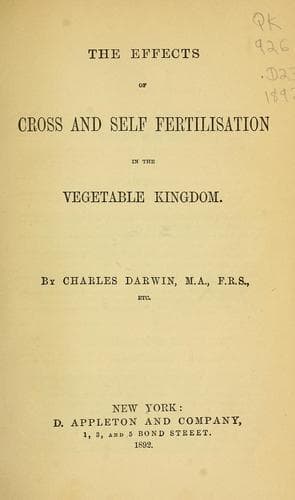
The Effects of Cross & Self-Fertilisation in the Vegetable KingdomDarwin, Charles
Science
The Effects of Cross & Self-Fertilisation in the Vegetable Kingdom
Darwin, Charles
Fertilization of plants; Plants -- Variation; Pollination
flower-stems as the latter, and were much less liable to premature
death.
2. Ipomoea purpurea.
Thirty-one intercrossed plants raised from a cross between flowers on
the same plants were grown in ten pots in competition with the same
number of self-fertilised plants, and the former were to the latter in
height as 100 to 105. So that the self-fertilised plants were a little
taller than the intercrossed; and in eight out of the ten pots a
self-fertilised plant flowered before any one of the crossed plants in
the same pots. The plants which were not greatly crowded in nine of the
pots (and these offer the fairest standard of comparison) were cut down
and weighed; and the weight of the twenty-seven intercrossed plants was
to that of the twenty-seven self-fertilised as 100 to 124; so that by
this test the superiority of the self-fertilised was strongly marked. To
this subject of the superiority of the self-fertilised plants in certain
cases, I shall have to recur in a future chapter. If we now turn to the
offspring from a cross between distinct plants when put into competition
with self-fertilised plants, we find that the mean height of
seventy-three such crossed plants, in the course of ten generations, was
to that of the same number of self-fertilised plants as 100 to 77; and
in the case of the plants of the tenth generation in weight as 100 to
44. Thus the contrast between the effects of crossing flowers on the
same plant, and of crossing flowers on distinct plants, is wonderfully
great.
3. Mimulus luteus.
Twenty-two plants raised by crossing flowers on the same plant were
grown in competition with the same number of self-fertilised plants; and
the former were to the latter in height as 100 to 105, and in weight as
100 to 103. Moreover, in seven out of the eight pots a self-fertilised
plant flowered before any of the intercrossed plants. So that here again
the self-fertilised exhibit a slight superiority over the intercrossed
plants. For the sake of comparison, I may add that seedlings raised
during three generations from a cross between distinct plants were to
the self-fertilised plants in height as 100 to 65.
4. Pelargonium zonale.
Two plants growing in separate pots, which had been propagated by
cuttings from the same plant, and therefore formed in fact parts of the
same individual, were intercrossed, and other flowers on one of these
plants were self-fertilised; but the seedlings obtained by the two
processes did not differ in height. When, on the other hand, flowers on
one of the above plants were crossed with pollen taken from a distinct
seedling, and other flowers were self-fertilised, the crossed offspring
thus obtained were to the self-fertilised in height as 100 to 74.
5. Origanum vulgare.
Public-domain text, read in full here on John Shaqi.
Reviews
Reviews
No reviews yet
Be the first to share your thoughts on this work.
Elsewhere in the archive
Join the Discussion
Join the discussion
Sign in to leave a comment or review.
Sign InorCreate an account