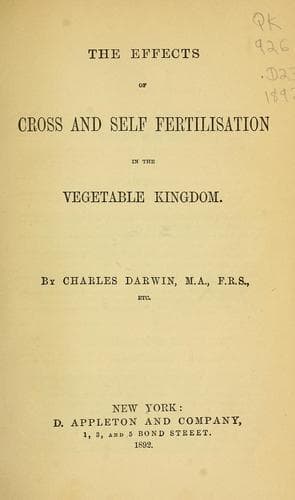
The Effects of Cross & Self-Fertilisation in the Vegetable KingdomDarwin, Charles
Science
The Effects of Cross & Self-Fertilisation in the Vegetable Kingdom
Darwin, Charles
Fertilization of plants; Plants -- Variation; Pollination
The order in which our subject will be treated in the present volume is
as follows. A long series of experiments will first be given in Chapters
2 to 6. Tables will afterwards be appended, showing in a condensed form
the relative heights, weights, and fertility of the offspring of the
various crossed and self-fertilised species. Another table exhibits the
striking results from fertilising plants, which during several
generations had either been self-fertilised or had been crossed with
plants kept all the time under closely similar conditions, with pollen
taken from plants of a distinct stock and which had been exposed to
different conditions. In the concluding chapters various related points
and questions of general interest will be discussed.
Anyone not specially interested in the subject need not attempt to read
all the details (marked []); though they possess, I think, some value,
and cannot be all summarised. But I would suggest to the reader to take
as an example the experiments on Ipomoea in Chapter 2; to which may be
added those on Digitalis, Origanum, Viola, or the common cabbage, as in
all these cases the crossed plants are superior to the self-fertilised
in a marked degree, but not in quite the same manner. As instances of
self-fertilised plants being equal or superior to the crossed, the
experiments on Bartonia, Canna, and the common pea ought to be read; but
in the last case, and probably in that of Canna, the want of any
superiority in the crossed plants can be explained.
Public-domain text, read in full here on John Shaqi.
Reviews
Reviews
No reviews yet
Be the first to share your thoughts on this work.
Join the Discussion
Join the discussion
Sign in to leave a comment or review.
Sign InorCreate an account