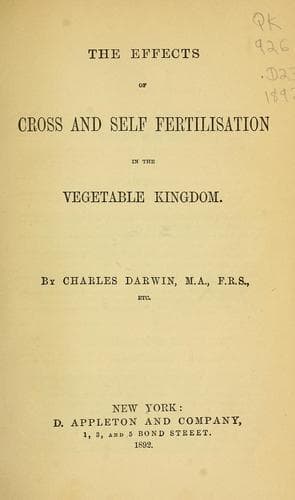
The Effects of Cross & Self-Fertilisation in the Vegetable Kingdom — John Shaqi
The Effects of Cross & Self-Fertilisation in the Vegetable KingdomDarwin, Charles
Science
The Effects of Cross & Self-Fertilisation in the Vegetable Kingdom
Darwin, Charles
Fertilization of plants; Plants -- Variation; Pollination
Species were selected for experiment belonging to widely distinct
families, inhabiting various countries. In some few cases several genera
belonging to the same family were tried, and these are grouped together;
but the families themselves have been arranged not in any natural order,
but in that which was the most convenient for my purpose. The
experiments have been fully given, as the results appear to me of
sufficient value to justify the details. Plants bearing hermaphrodite
flowers can be interbred more closely than is possible with bisexual
animals, and are therefore well-fitted to throw light on the nature and
extent of the good effects of crossing, and on the evil effects of close
interbreeding or self-fertilisation. The most important conclusion at
which I have arrived is that the mere act of crossing by itself does no
good. The good depends on the individuals which are crossed differing
slightly in constitution, owing to their progenitors having been
subjected during several generations to slightly different conditions,
or to what we call in our ignorance spontaneous variation. This
conclusion, as we shall hereafter see, is closely connected with various
important physiological problems, such as the benefit derived from
slight changes in the conditions of life, and this stands in the closest
connection with life itself. It throws light on the origin of the two
sexes and on their separation or union in the same individual, and
lastly on the whole subject of hybridism, which is one of the greatest
obstacles to the general acceptance and progress of the great principle
of evolution.
In order to avoid misapprehension, I beg leave to repeat that throughout
this volume a crossed plant, seedling, or seed, means one of crossed
PARENTAGE, that is, one derived from a flower fertilised with pollen
from a distinct plant of the same species. And that a self-fertilised
plant, seedling, or seed, means one of self-fertilised PARENTAGE, that
is, one derived from a flower fertilised with pollen from the same
flower, or sometimes, when thus stated, from another flower on the same
plant.
CHAPTER II.
CONVOLVULACEAE.
Ipomoea purpurea, comparison of the height and fertility of the crossed
and self-fertilised plants during ten successive generations.
Greater constitutional vigour of the crossed plants.
The effects on the offspring of crossing different flowers on the same
plant, instead of crossing distinct individuals.
The effects of a cross with a fresh stock.
The descendants of the self-fertilised plant named Hero.
Summary on the growth, vigour, and fertility of the successive crossed
and self-fertilised generations.
Small amount of pollen in the anthers of the self-fertilised plants of
the later generations, and the sterility of their first-produced
flowers.
Uniform colour of the flowers produced by the self-fertilised plants.
The advantage from a cross between two distinct plants depends on their
differing in constitution.
Public-domain text, read in full here on John Shaqi.
Reviews
Reviews
No reviews yet
Be the first to share your thoughts on this work.
Join the Discussion
Join the discussion
Sign in to leave a comment or review.
Sign InorCreate an account