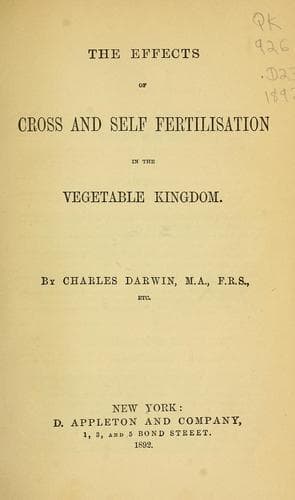
The Effects of Cross & Self-Fertilisation in the Vegetable Kingdom — John Shaqi
The Effects of Cross & Self-Fertilisation in the Vegetable KingdomDarwin, Charles
Science
The Effects of Cross & Self-Fertilisation in the Vegetable Kingdom
Darwin, Charles
Fertilization of plants; Plants -- Variation; Pollination
Number of species and plants measured.--Tables given.--Preliminary
remarks on the offspring of plants crossed by a fresh stock.--Thirteen
cases specially considered.--The effects of crossing a self-fertilised
plant either by another self-fertilised plant or by an intercrossed
plant of the old stock.--Summary of the results.--Preliminary remarks on
the crossed and self-fertilised plants of the same stock.--The
twenty-six exceptional cases considered, in which the crossed plants did
not exceed greatly in height the self-fertilised.--Most of these cases
shown not to be real exceptions to the rule that cross-fertilisation is
beneficial.--Summary of results.--Relative weights of the crossed and
self-fertilised plants.
CHAPTER VIII.
DIFFERENCE BETWEEN CROSSED AND SELF-FERTILISED PLANTS IN CONSTITUTIONAL
VIGOUR AND IN OTHER RESPECTS.
Greater constitutional vigour of crossed plants.--The effects of great
crowding.--Competition with other kinds of plants.--Self-fertilised
plants more liable to premature death.--Crossed plants generally flower
before the self-fertilised.--Negative effects of intercrossing flowers
on the same plant.--Cases described.--Transmission of the good effects
of a cross to later generations.--Effects of crossing plants of closely
related parentage.--Uniform colour of the flowers on plants
self-fertilised during several generations and cultivated under similar
conditions.
CHAPTER IX.
THE EFFECTS OF CROSS-FERTILISATION AND SELF-FERTILISATION ON THE
PRODUCTION OF SEEDS.
Fertility of plants of crossed and self-fertilised parentage, both lots
being fertilised in the same manner.--Fertility of the parent-plants
when first crossed and self-fertilised, and of their crossed and
self-fertilised offspring when again crossed and
self-fertilised.--Comparison of the fertility of flowers fertilised with
their own pollen and with that from other flowers on the same
plant.--Self-sterile plants.--Causes of self-sterility.--The appearance
of highly self-fertile varieties.--Self-fertilisation apparently in some
respects beneficial, independently of the assured production of
seeds.--Relative weights and rates of germination of seeds from crossed
and self-fertilised flowers.
CHAPTER X.
MEANS OF FERTILISATION.
Sterility and fertility of plants when insects are excluded.--The means
by which flowers are cross-fertilised.--Structures favourable to
self-fertilisation.--Relation between the structure and conspicuousness
of flowers, the visits of insects, and the advantages of
cross-fertilisation.--The means by which flowers are fertilised with
pollen from a distinct plant.--Greater fertilising power of such
pollen.--Anemophilous species.--Conversion of anemophilous species into
entomophilous.--Origin of nectar.--Anemophilous plants generally have
their sexes separated.--Conversion of diclinous into hermaphrodite
flowers.--Trees often have their sexes separated.
CHAPTER XI.
THE HABITS OF INSECTS IN RELATION TO THE FERTILISATION OF FLOWERS.
Public-domain text, read in full here on John Shaqi.
Reviews
Reviews
No reviews yet
Be the first to share your thoughts on this work.
Join the Discussion
Join the discussion
Sign in to leave a comment or review.
Sign InorCreate an account