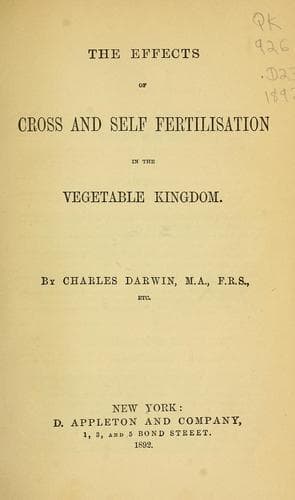
The Effects of Cross & Self-Fertilisation in the Vegetable KingdomDarwin, Charles
Science
The Effects of Cross & Self-Fertilisation in the Vegetable Kingdom
Darwin, Charles
Fertilization of plants; Plants -- Variation; Pollination
There is weighty and abundant evidence that the flowers of most kinds of
plants are constructed so as to be occasionally or habitually
cross-fertilised by pollen from another flower, produced either by the
same plant, or generally, as we shall hereafter see reason to believe,
by a distinct plant. Cross-fertilisation is sometimes ensured by the
sexes being separated, and in a large number of cases by the pollen and
stigma of the same flower being matured at different times. Such plants
are called dichogamous, and have been divided into two sub-classes:
proterandrous species, in which the pollen is mature before the stigma,
and proterogynous species, in which the reverse occurs; this latter form
of dichogamy not being nearly so common as the other.
Cross-fertilisation is also ensured, in many cases, by mechanical
contrivances of wonderful beauty, preventing the impregnation of the
flowers by their own pollen. There is a small class of plants, which I
have called dimorphic and trimorphic, but to which Hildebrand has given
the more appropriate name of heterostyled; this class consists of plants
presenting two or three distinct forms, adapted for reciprocal
fertilisation, so that, like plants with separate sexes, they can hardly
fail to be intercrossed in each generation. The male and female organs
of some flowers are irritable, and the insects which touch them get
dusted with pollen, which is thus transported to other flowers. Again,
there is a class, in which the ovules absolutely refuse to be fertilised
by pollen from the same plant, but can be fertilised by pollen from any
other individual of the same species. There are also very many species
which are partially sterile with their own pollen. Lastly, there is a
large class in which the flowers present no apparent obstacle of any
kind to self-fertilisation, nevertheless these plants are frequently
intercrossed, owing to the prepotency of pollen from another individual
or variety over the plant’s own pollen.
As plants are adapted by such diversified and effective means for
cross-fertilisation, it might have been inferred from this fact alone
that they derived some great advantage from the process; and it is the
object of the present work to show the nature and importance of the
benefits thus derived. There are, however, some exceptions to the rule
of plants being constructed so as to allow of or to favour
cross-fertilisation, for some few plants seem to be invariably
self-fertilised; yet even these retain traces of having been formerly
adapted for cross-fertilisation. These exceptions need not make us doubt
the truth of the above rule, any more than the existence of some few
plants which produce flowers, and yet never set seed, should make us
doubt that flowers are adapted for the production of seed and the
propagation of the species.
Public-domain text, read in full here on John Shaqi.
Reviews
Reviews
No reviews yet
Be the first to share your thoughts on this work.
Join the Discussion
Join the discussion
Sign in to leave a comment or review.
Sign InorCreate an account