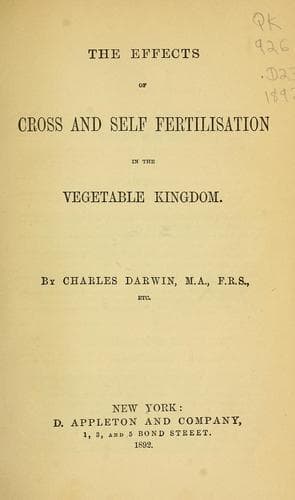
The Effects of Cross & Self-Fertilisation in the Vegetable KingdomDarwin, Charles
Science
The Effects of Cross & Self-Fertilisation in the Vegetable Kingdom
Darwin, Charles
Fertilization of plants; Plants -- Variation; Pollination
We should always keep in mind the obvious fact that the production of
seed is the chief end of the act of fertilisation; and that this end can
be gained by hermaphrodite plants with incomparably greater certainty by
self-fertilisation, than by the union of the sexual elements belonging
to two distinct flowers or plants. Yet it is as unmistakably plain that
innumerable flowers are adapted for cross-fertilisation, as that the
teeth and talons of a carnivorous animal are adapted for catching prey;
or that the plumes, wings, and hooks of a seed are adapted for its
dissemination. Flowers, therefore, are constructed so as to gain two
objects which are, to a certain extent, antagonistic, and this explains
many apparent anomalies in their structure. The close proximity of the
anthers to the stigma in a multitude of species favours, and often
leads, to self-fertilisation; but this end could have been gained far
more safely if the flowers had been completely closed, for then the
pollen would not have been injured by the rain or devoured by insects,
as often happens. Moreover, in this case, a very small quantity of
pollen would have been sufficient for fertilisation, instead of millions
of grains being produced. But the openness of the flower and the
production of a great and apparently wasteful amount of pollen are
necessary for cross-fertilisation. These remarks are well illustrated by
the plants called cleistogene, which bear on the same stock two kinds of
flowers. The flowers of the one kind are minute and completely closed,
so that they cannot possibly be crossed; but they are abundantly
fertile, although producing an extremely small quantity of pollen. The
flowers of the other kind produce much pollen and are open; and these
can be, and often are, cross-fertilised. Hermann Muller has also made
the remarkable discovery that there are some plants which exist under
two forms; that is, produce on distinct stocks two kinds of
hermaphrodite flowers. The one form bears small flowers constructed for
self-fertilisation; whilst the other bears larger and much more
conspicuous flowers plainly constructed for cross-fertilisation by the
aid of insects; and without their aid these produce no seed.
Public-domain text, read in full here on John Shaqi.
Reviews
Reviews
No reviews yet
Be the first to share your thoughts on this work.
Join the Discussion
Join the discussion
Sign in to leave a comment or review.
Sign InorCreate an account