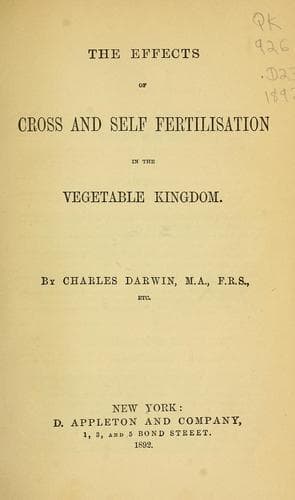
The Effects of Cross & Self-Fertilisation in the Vegetable KingdomDarwin, Charles
Science
The Effects of Cross & Self-Fertilisation in the Vegetable Kingdom
Darwin, Charles
Fertilization of plants; Plants -- Variation; Pollination
The adaptation of flowers for cross-fertilisation is a subject which has
interested me for the last thirty-seven years, and I have collected a
large mass of observations, but these are now rendered superfluous by
the many excellent works which have been lately published. In the year
1857 I wrote a short paper on the fertilisation of the kidney bean (1/1.
‘Gardeners’ Chronicle’ 1857 page 725 and 1858 pages 824 and 844. ‘Annals
and Magazine of Natural History’ 3rd series volume 2 1858 page 462.);
and in 1862 my work ‘On the Contrivances by which British and Foreign
Orchids are Fertilised by Insects’ appeared. It seemed to me a better
plan to work out one group of plants as carefully as I could, rather
than to publish many miscellaneous and imperfect observations. My
present work is the complement of that on Orchids, in which it was shown
how admirably these plants are constructed so as to permit of, or to
favour, or to necessitate cross-fertilisation. The adaptations for
cross-fertilisation are perhaps more obvious in the Orchideae than in
any other group of plants, but it is an error to speak of them, as some
authors have done, as an exceptional case. The lever-like action of the
stamens of Salvia (described by Hildebrand, Dr. W. Ogle, and others), by
which the anthers are depressed and rubbed on the backs of bees, shows
as perfect a structure as can be found in any orchid. Papilionaceous
flowers, as described by various authors--for instance, by Mr. T.H.
Farrer--offer innumerable curious adaptations for cross-fertilisation.
The case of Posoqueria fragrans (one of the Rubiaceae), is as wonderful
as that of the most wonderful orchid. The stamens, according to Fritz
Muller, are irritable, so that as soon as a moth visits a flower, the
anthers explode and cover the insect with pollen; one of the filaments
which is broader than the others then moves and closes the flower for
about twelve hours, after which time it resumes its original position.
(1/2. ‘Botanische Zeitung’ 1866 page 129.) Thus the stigma cannot be
fertilised by pollen from the same flower, but only by that brought by a
moth from some other flower. Endless other beautiful contrivances for
this same purpose could be specified.
Public-domain text, read in full here on John Shaqi.
Reviews
Reviews
No reviews yet
Be the first to share your thoughts on this work.
Join the Discussion
Join the discussion
Sign in to leave a comment or review.
Sign InorCreate an account