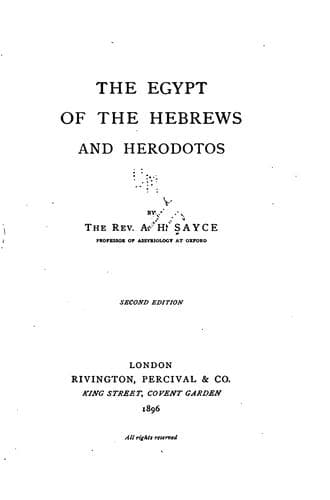
The Egypt of the Hebrews and HerodotosSayce, A. H. (Archibald Henry)
History
The Egypt of the Hebrews and Herodotos
Sayce, A. H. (Archibald Henry)
Egypt -- History, Ancient
Even the official language and writing were of Asiatic derivation. The
language was that of Babylonia, the script was the cuneiform syllabary of
the same country. The Babylonian script and language were used from the
banks of the Euphrates to those of the Nile. They were the common medium
of intercourse throughout the civilised world. It is in these that an
Egyptian official writes to his master, and it is again in these that the
reply is sent from the Egyptian foreign office.
The fact is a very surprising one, but recent discoveries have tended to
explain it. At a very remote epoch Babylonian armies had made their way to
the west, and Palestine was a province of Babylonia long before it became
a province of Egypt. The long-continued and deep-seated influence of
Babylonia brought to it the culture and civilisation of the Babylonian
cities. The Babylonian system of writing formed a very important element
in this ancient culture, and, along with the language of which it was the
expression, took deep root in Western Asia. How long it continued to be
employed there may be gathered from the fact that each district of Western
Asia developed its own peculiar form of cuneiform script.
All this we have learned from a discovery made in 1887 in the mounds of
Tel el-Amarna. Among the ruins of the foreign office of Khu-n-Aten, which
adjoined the royal palace, the _fellahin_ found a collection of clay
tablets inscribed with cuneiform or wedge-shaped characters. They turned
out to be the foreign correspondence of Khu-n-Aten and his father. When
Khu-n-Aten quitted Thebes he took with him the archives of his father, and
to these were subsequently added the official letters which he himself
received.
Altogether, about three hundred tablets were discovered. But no one was on
the spot who could appreciate their value, and, owing to a series of
deplorable accidents, several of them were injured or destroyed before
they fell into European hands. Eighty-two found their way to the British
Museum, more than 160 fragments are at Berlin, the Gizeh Museum possesses
56, and a few are in the hands of private individuals.
Public-domain text, read in full here on John Shaqi.
Reviews
Reviews
No reviews yet
Be the first to share your thoughts on this work.
Join the Discussion
Join the discussion
Sign in to leave a comment or review.
Sign InorCreate an account