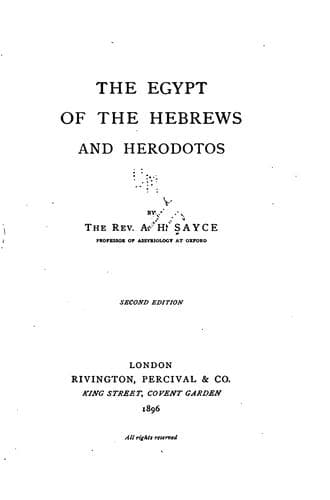
The Egypt of the Hebrews and Herodotos — John Shaqi
The Egypt of the Hebrews and HerodotosSayce, A. H. (Archibald Henry)
History
The Egypt of the Hebrews and Herodotos
Sayce, A. H. (Archibald Henry)
Egypt -- History, Ancient
The tablets have thrown a new and unexpected light on the history of the
past. To find that the language and script of Babylonia were the common
medium of literary and official intercourse throughout Western Asia in the
century before the Exodus was sufficiently startling; it was much more
startling to find that this early period was emphatically a literary era.
Letters passed to and fro along the high-roads upon the most trifling
subjects, and a constant correspondence was maintained between the court
of the Pharaoh and the most distant parts of Western Asia. The Bedouin
chiefs beyond the Jordan send letters protesting their loyalty to the
Egyptian monarch, and declaring that their forces were at his disposal;
the vassal-king of Jerusalem begs for help from Egypt to protect him
against his personal enemies; the governors of Phœnicia and the land of
the Amorites describe the threatening attitude of the Hittites in the
north; the king of Mitanni or Aram-Naharaim dwells with pride on his
relationship to the ruler of the Egyptian empire; while the kings of
Assyria and Babylonia ask that gold may be sent them from Egypt, where it
is as plentiful as “the dust,” or discuss questions of international
policy or commercial interest. We are suddenly transported to a world much
like our own;—a world in which education is widely spread, where schools
and scholars abound, and libraries and archive-chambers exist.
The nature of the cuneiform system of writing would of itself indicate
that schools were numerous. It was a system which was extraordinarily
difficult to learn. Unlike the hieroglyphs of Egypt, no assistance was
afforded to the memory by any resemblance between the characters and
external objects; like the Chinese characters of to-day, they consisted
merely of groups of conventionally arranged lines or wedges. Like the
Egyptian hieroglyphs, however, the number of characters was extremely
large, and each character not only represented more than one phonetic
value, but it could also be used ideographically to express ideas. Thus
the same character may not only represent the phonetic values _kur_,
_mat_, _nat_, _lat_, _sat_, and _gin_; it may also denote the ideas of
“country,” “mountain,” and “conquest.” But this was not all. The original
picture-writing out of which the cuneiform syllabary developed, had been
invented by the primitive non-Semitic population of Chaldæa, from whom it
had been afterwards adopted and adapted by their Semitic successors.
Accordingly, whole groups of characters which denoted a particular word in
Sumerian—the non-Semitic language of ancient Chaldæa—were taken over by
the Semites and used by them to denote the same word, though, of course,
with a totally different pronunciation. In Sumerian, for example,
_mer-sig_ signified “trousers,” but though the two characters _mer_ and
_sig_ continued to be written in Semitic times in order to express the
word, the pronunciation attached to them was _sarbillu_, the modern Arabic
Public-domain text, read in full here on John Shaqi.
Reviews
Reviews
No reviews yet
Be the first to share your thoughts on this work.
Join the Discussion
Join the discussion
Sign in to leave a comment or review.
Sign InorCreate an account